
June 14, 2026 a 05:08 am
USDCAD: Fibonacci Analysis
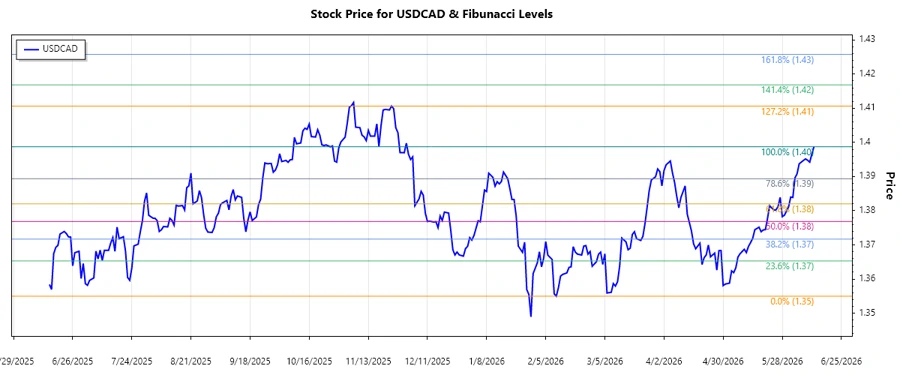
The USDCAD currency pair has recently shown a dominant upward trend, driven by strong economic indicators in the U.S. This upward movement suggests increased investor confidence, likely driven by anticipation of more favorable interest rates. However, fluctuations in oil prices, which are pivotal to Canada’s economy, could catalyze volatility in this pair.
Fibonacci Analysis
The analysis covers a trend from late February 2026 to mid-June 2026, starting with a low of 1.35497 on February 10, 2026, reaching a high of 1.39873 on June 12, 2026. Based on this, the precise Fibonacci retracement levels are calculated.
| Start Date | End Date | High Price & Date | Low Price & Date |
|---|---|---|---|
| 2026-02-10 | 2026-06-12 | 1.39873 (2026-06-12) | 1.35497 (2026-02-10) |
| Fibonacci Levels | Price Levels |
|---|---|
| 0.236 | 1.36732 |
| 0.382 | 1.37638 |
| 0.500 | 1.37685 |
| 0.618 | 1.38275 |
| 0.786 | 1.39127 |
The current price of 1.39873 is above the calculated Fibonacci retracement levels, indicating that the price remains in an upward trend with potential support forming at these levels.
This retracement analysis suggests that potential support areas could align with any pullback, favoring buyers.
Conclusion
The USDCAD has maintained an upward trajectory with support expected at key Fibonacci levels. Analysts should watch for any potential price consolidation within these retracement levels, which could offer strategic entry points. However, unexpected economic policy shifts or oil price movements could introduce unforeseen risks. Proper monitoring of the global and domestic economic landscape remains essential for making informed trading decisions.
Smart Data Insight
Master the Perfect Entry & Exit for this Stock
Don't leave your profits to chance. Historically, this stock follows specific seasonal patterns that institutional traders use to maximize returns.
- ✅ Identify the "Golden Buying Window"
- ✅ Avoid high-risk correction cycles
- ✅ Backtested data from the last 20+ years