
March 09, 2026 a 11:31 am
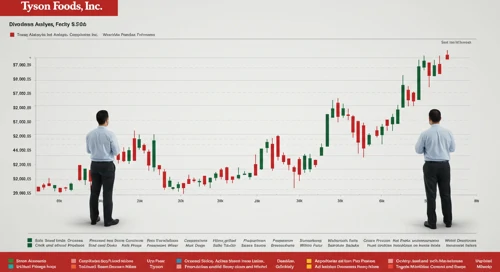


TSN: Dividend Analysis - Tyson Foods, Inc.
Tyson Foods, Inc. presents a compelling dividend opportunity with a yield of 3.30%, supported by a consistent history of payments over 39 years. The company's recent challenges with profitability, as reflected in its high EPS payout ratio, warrant caution. Nevertheless, steady dividend growth of 3.35% over the past five years indicates stable financial planning.
📊 Overview
An in-depth analysis of Tyson Foods, Inc.'s dividend metrics reveals a robust historical commitment to shareholder returns.
| Parameter | Value |
|---|---|
| Sector | Consumer Goods |
| Dividend Yield | 3.30% |
| Current Dividend Per Share | 2.00 USD |
| Dividend History | 39 years |
| Last Cut or Suspension | None |
🗣️ Dividend History
The dividend history of Tyson Foods, Inc. highlights a remarkable resilience in maintaining payouts, confirming investor confidence.
| Year | Dividend Per Share (USD) |
|---|---|
| 2026 | 1.02 |
| 2025 | 2.01 |
| 2024 | 1.97 |
| 2023 | 1.93 |
| 2022 | 1.86 |
📈 Dividend Growth
Analyzing the dividend growth is crucial as it reflects the company's profitability and strategic financial management.
| Time | Growth |
|---|---|
| 3 years | 2.62% |
| 5 years | 3.35% |
The average dividend growth is 3.35% over 5 years. This shows moderate but steady dividend growth.
📉 Payout Ratio
Payout ratios are critical indicators of financial health; a balance is essential to ensure sustainable dividend policies.
| Key Figure | Ratio |
|---|---|
| EPS-based | 345.50% |
| Free Cash Flow-based | 64.46% |
The remarkably high EPS payout ratio of 345.50% could signal potential unsustainable practices if sustained, while the FCF payout demonstrates moderate coverage.
✅ Cashflow & Capital Efficiency
Reviewing cash flows and capital efficiency provides insights into operational prudence and future growth potential.
| Metric | 2025 | 2024 | 2023 |
|---|---|---|---|
| Free Cash Flow Yield | 6.24% | 6.90% | -1.05% |
| Earnings Yield | 2.51% | 3.79% | -3.63% |
| CAPEX to Operating Cash Flow | 45.38% | 43.71% | 110.67% |
| Stock-based Compensation to Revenue | 0.18% | 0.19% | 0.12% |
| Free Cash Flow / Operating Cash Flow Ratio | 54.62% | 56.29% | -10.67% |
⚠️ Balance Sheet & Leverage Analysis
Understanding the balance sheet and leverage provides a snapshot of financial health and risk assessment.
| Metric | 2025 | 2024 | 2023 |
|---|---|---|---|
| Debt-to-Equity | 0.49 | 0.53 | 0.52 |
| Debt-to-Assets | 0.24 | 0.26 | 0.26 |
| Debt-to-Capital | 0.33 | 0.35 | 0.34 |
| Net Debt to EBITDA | 2.95 | 2.71 | 8.79 |
| Current Ratio | 1.55 | 2.04 | 1.34 |
| Quick Ratio | 0.66 | 0.95 | 0.52 |
| Financial Leverage | 2.03 | 2.02 | 1.99 |
🗣️ Fundamental Strength & Profitability
Evaluating fundamental strengths and profitability aids in understanding the company's capacity for growth and sustainability.
| Metric | 2025 | 2024 | 2023 |
|---|---|---|---|
| Return on Equity | 2.62% | 4.35% | -3.57% |
| Return on Assets | 1.29% | 2.16% | -1.79% |
| Margins: Net | 0.87% | 1.50% | -1.23% |
| Margins: EBIT | 2.24% | 2.95% | -0.61% |
| Margins: EBITDA | 4.74% | 5.58% | 1.92% |
| Margins: Gross | 6.54% | 6.80% | 4.98% |
| Research & Development to Revenue | 0.23% | 0.20% | 0.22% |
📈 Price Development
✅ Dividend Scoring System
| Criteria | Score | Score Bar |
|---|---|---|
| Dividend Yield | 4 | |
| Dividend Stability | 5 | |
| Dividend Growth | 3 | |
| Payout Ratio | 2 | |
| Financial Stability | 3 | |
| Dividend Continuity | 5 | |
| Cashflow Coverage | 3 | |
| Balance Sheet Quality | 3 |
Total Score: 28/40
✅ Rating
Tyson Foods, Inc. maintains a steady dividend track record with moderate growth potential. Despite recent profitability concerns, the firm has demonstrated resilience and a commitment to sustaining its dividend policy. Investors should consider the firm's ability to tackle its high payout ratio and leverage in assessing long-term opportunities. Overall, Tyson Foods offers a balanced dividend play in its sector, with a total score indicating a moderately attractive investment proposition.