
August 16, 2026 a 12:31 pm


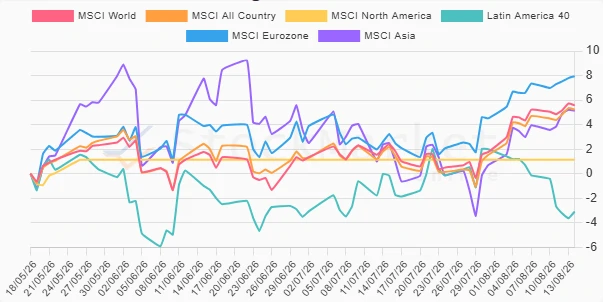
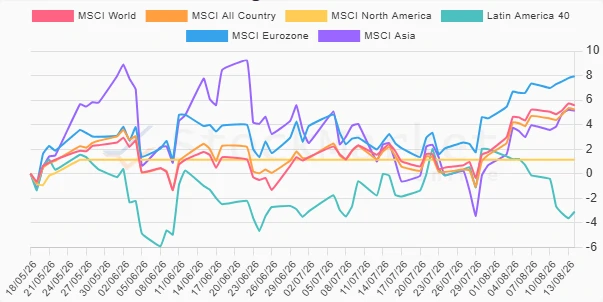
🌍 Region - Performance Analysis
The global asset performance shows a mixed landscape across various regions. While some regions have experienced robust growth, others have faced downturns. Analyzing these trends offers insights into geographic market dynamics, helping investors make informed decisions.
📊 Region Performance One Week
| Region | Performance (%) | Performance |
|---|---|---|
| MSCI Asia | 1.18% | |
| MSCI Eurozone | 0.58% | |
| MSCI All Country | 0.52% | |
| MSCI World | 0.36% | |
| MSCI North America | 0.0% | |
| Latin America 40 | -2.96% |
📊 Region Performance One Month
| Region | Performance (%) | Performance |
|---|---|---|
| MSCI Eurozone | 5.86% | |
| MSCI Asia | 5.76% | |
| MSCI All Country | 4.65% | |
| MSCI World | 4.58% | |
| MSCI North America | 0.0% | |
| Latin America 40 | -1.23% |
📊 Region Performance Three Months
| Region | Performance (%) | Performance |
|---|---|---|
| MSCI Eurozone | 7.94% | |
| MSCI World | 5.58% | |
| MSCI All Country | 5.23% | |
| MSCI Asia | 5.13% | |
| MSCI North America | 1.14% | |
| Latin America 40 | -3.09% |
✅ Summary
The analysis over different time frames reveals that the MSCI Eurozone has consistently outperformed other regions, especially over the last three months. In contrast, Latin America faces challenges with negative returns across the board. Notably, North America’s flat performance signals stability but lacks growth. Investors may consider diversifying portfolios with exposure to the Eurozone to capitalize on its upward trajectory while being cautious of potential volatility in Latin America.
Smart Data Insight
Master the Perfect Entry & Exit for this Stock
Don't leave your profits to chance. Historically, this stock follows specific seasonal patterns that institutional traders use to maximize returns.
- ✅ Identify the "Golden Buying Window"
- ✅ Avoid high-risk correction cycles
- ✅ Backtested data from the last 20+ years