
December 05, 2025 a 12:47 pm

PNW: Dividend Analysis - Pinnacle West Capital Corporation
Pinnacle West Capital Corporation has consistently demonstrated its commitment to shareholders through stable dividend payouts over the years. With a history of 37 consecutive years of dividend payments without cuts since 1993, the company's dividend stability is commendable. However, the high payout ratios relative to its earnings and cash flow suggest the need for close monitoring as it can affect future dividend sustainability. Investors should weigh these factors carefully when considering PNW as a dividend play.
📊 Overview
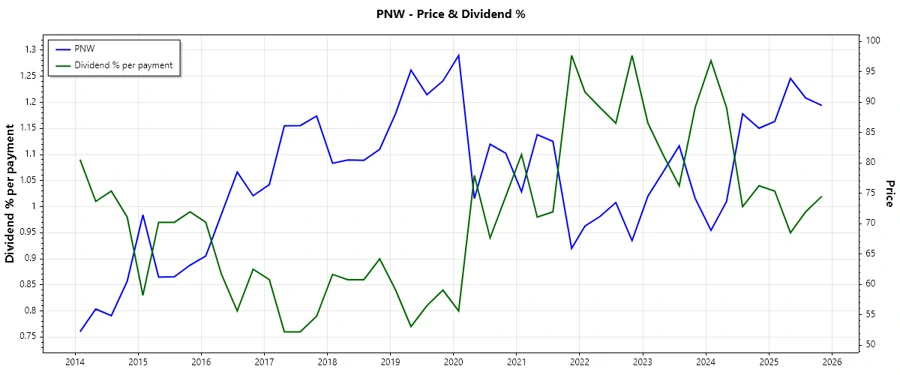
Pinnacle West Capital Corporation's position in the Utilities sector is bolstered by a current dividend yield of 4.02% and a dividend per share of $3.47. The company's uninterrupted dividend history for 37 years highlights its commitment to rewarding shareholders. No dividend cuts or suspensions have been noted since 1993, which speaks to resilience and management's priorities.
| Key Metric | Value |
|---|---|
| Sector | Utilities |
| Dividend Yield | 4.02% |
| Current Dividend Per Share | $3.47 |
| Dividend History | 37 years |
| Last Cut/Suspension | 1993 |
📈 Dividend History
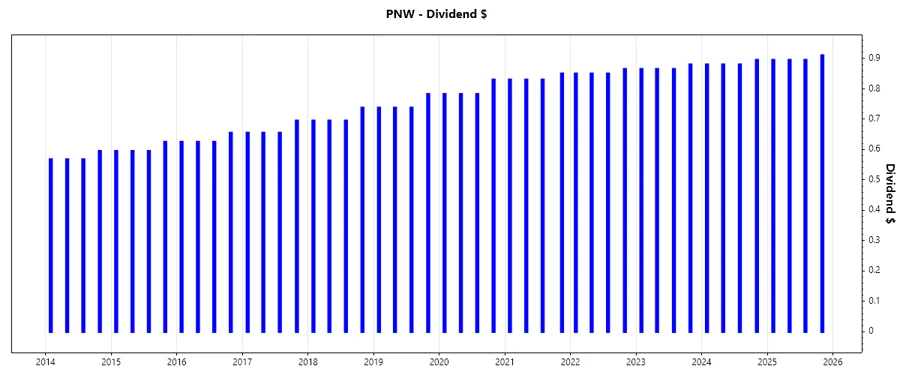
Understanding Pinnacle West's dividend history is vital as it demonstrates the company's ability to return value to shareholders over time. The steady increase in dividends despite economic cycles indicates robust earnings support and prudent management practices.
| Year | Dividend Per Share (USD) |
|---|---|
| 2025 | 3.595 |
| 2024 | 3.535 |
| 2023 | 3.475 |
| 2022 | 3.415 |
| 2021 | 3.340 |
📈 Dividend Growth
The consistency of Pinnacle West's dividend growth, though moderate, reflects a calculated approach to balancing shareholder rewards with corporate reinvestment. This stability often appeals to investors seeking dependable income streams.
| Time | Growth |
|---|---|
| 3 years | 1.91% |
| 5 years | 3.37% |
The average dividend growth is 3.37% over 5 years. This shows moderate but steady dividend growth.
📉 Payout Ratio
The payout ratio is a key indicator of dividend safety. Pinnacle West's EPS-based payout ratio is high at 69.78%, providing some concern regarding future increases. The FCF-based payout, negative at -57.71%, suggests a potential stress point in cash flow coverage that investors should attentively monitor.
| Key Figure | Ratio |
|---|---|
| EPS-based | 69.78% |
| Free Cash Flow-based | -57.71% |
Pinnacle West's EPS payout ratio at 69.78% is near the upper bound of desirable limits, indicating that the company is returning a significant portion of its earnings to shareholders. The negative FCF payout ratio is worrisome, suggesting that dividends are not fully supported by cash flow, which could affect sustainability.
✅ Cashflow & Capital Efficiency
A thorough cash flow analysis for Pinnacle West highlights the company's operational efficiency. The negative Free Cash Flow Yield in recent years requires scrutiny. Investors should also consider CAPEX trends illustrating how investments are financed relative to cash operations.
| Year | 2024 | 2023 | 2022 |
|---|---|---|---|
| Free Cash Flow Yield | -6.63% | -7.84% | -5.41% |
| Earnings Yield | 6.31% | 6.15% | 5.62% |
| CAPEX to Operating Cash Flow | 140.67% | 152.88% | 137.54% |
| Stock-based Compensation to Revenue | 0% | 0.37% | 0.36% |
| Free Cash Flow / Operating Cash Flow Ratio | -39.72% | -52.88% | -37.54% |
The analysis suggests a cautious approach due to the negative free cash flow yield, which impacts the firm's ability to fund dividends organically. CAPEX exceeding operating cash flow indicates heavy investment activity that can strain liquidity.
🗣️ Balance Sheet & Leverage Analysis
An assessment of Pinnacle West’s leverage reveals substantial reliance on debt financing. The Debt-to-Equity ratio exceeds industry averages, necessitating ongoing assessment of servicing capabilities through metrics such as net debt to EBITDA.
| Year | 2024 | 2023 | 2022 |
|---|---|---|---|
| Debt-to-Equity | 1.64 | 1.67 | 1.47 |
| Debt-to-Assets | 42.33% | 41.78% | 39.07% |
| Debt-to-Capital | 62.06% | 62.52% | 59.48% |
| Net Debt to EBITDA | 5.33 | 5.78 | 5.38 |
| Current Ratio | 0.61 | 0.67 | 0.99 |
| Quick Ratio | 0.42 | 0.50 | 0.74 |
| Financial Leverage | 3.86 | 3.99 | 3.76 |
The high reliance on leverage amplifies financial risk, especially with rising interest rates potentially impacting debt servicing costs. Liquidity ratios illustrate increased pressure with a need for strategic balance sheet management to mitigate risk.
📉 Fundamental Strength & Profitability
Examining Pinnacle West’s fundamentals, moderate returns on equity and assets indicate efficient equity usage. Margin analysis shows robust figures, though heavily reliant on utility rates, impacting overall financial versatility.
| Year | 2024 | 2023 | 2022 |
|---|---|---|---|
| Return on Equity | 9.01% | 8.12% | 8.00% |
| Return on Assets | 2.33% | 2.03% | 2.13% |
| Net Margin | 11.88% | 10.68% | 11.18% |
| EBIT Margin | 21.74% | 19.74% | 19.22% |
| EBITDA Margin | 40.40% | 37.93% | 38.13% |
| Gross Margin | 41.70% | 39.28% | 39.50% |
| R&D to Revenue | 0% | 0% | 0% |
Pinnacle West exhibits strong net and EBIT margins, indicating effective cost management. However, the lack of R&D to revenue allocations underscores a reliance on existing technologies without pioneering innovation costs.
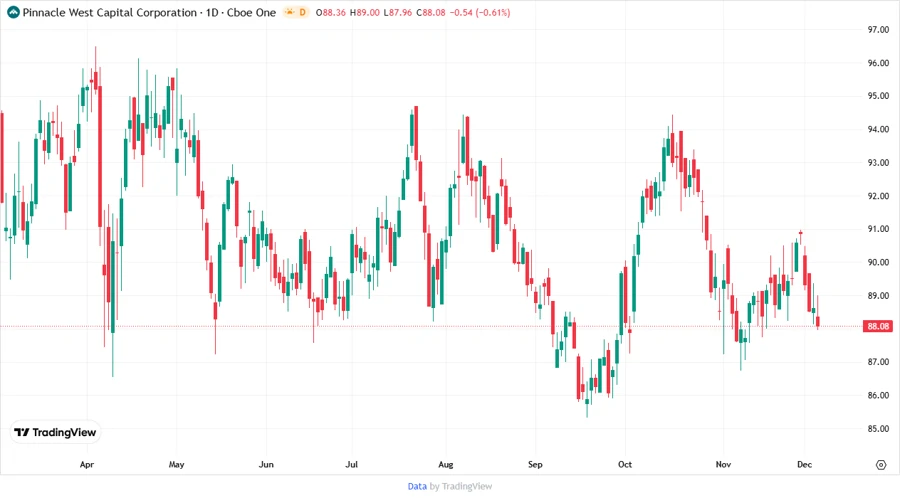
📈 Price Development
✅ Dividend Scoring System
| Criteria | Score | Rating |
|---|---|---|
| Dividend Yield | 4 | |
| Dividend Stability | 5 | |
| Dividend Growth | 3 | |
| Payout Ratio | 3 | |
| Financial Stability | 3 | |
| Dividend Continuity | 5 | |
| Cashflow Coverage | 2 | |
| Balance Sheet Quality | 3 |
Total Score: 28/40
🔍 Rating
Overall, Pinnacle West Capital Corporation presents a solid dividend investment opportunity, particularly for those valuing stability and consistent yield. However, potential investors should remain cautious of current leverage and negative free cash flow trends. Consider a balanced portfolio integration strategy to mitigate associated risks.
Smart Data Insight
Master the Perfect Entry & Exit for this Stock
Don't leave your profits to chance. Historically, this stock follows specific seasonal patterns that institutional traders use to maximize returns.
- ✅ Identify the "Golden Buying Window"
- ✅ Avoid high-risk correction cycles
- ✅ Backtested data from the last 20+ years