
October 22, 2025 a 03:31 am

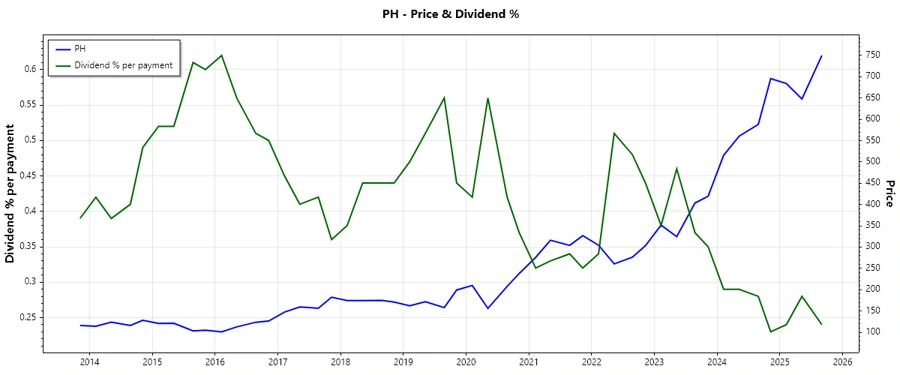
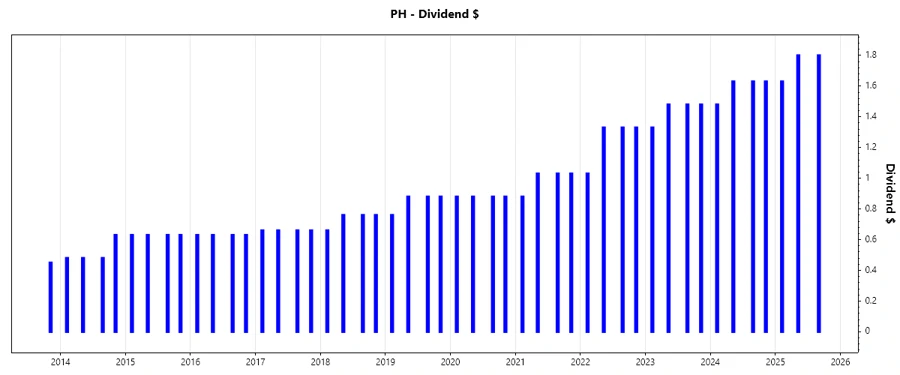

PH: Dividend Analysis - Parker-Hannifin Corporation
Parker-Hannifin Corporation displays a resilient dividend profile with steady growth and a strong historical payout track record, appealing to long-term income-focused investors. With a solid financial structure and robust earnings, it continues to demonstrate its ability to maintain a reliable dividend policy.
📊 Overview
Parker-Hannifin Corporation, operating in a vast industrial sector, is distinguished by its commitment to shareholder returns, evidenced through its consistent dividend payments over the last 41 years. The current dividend yield stands at 0.91%, matched by a substantial current dividend per share of 6.71 USD, making it a potentially attractive choice for income-seeking investors.
| Sector | Dividend Yield | Current Dividend Per Share | Dividend History | Last Cut or Suspension |
|---|---|---|---|---|
| Industrial | 0.91% | 6.71 USD | 41 years | None |
📈 Dividend History
The historical dividend trajectory of Parker-Hannifin showcases reliability and consistency, pivotal for income investors seeking stable cash flow. This history underscores the company's financial health and its capability to sustain payouts even during economic downturns.
| Year | Dividend Per Share (USD) |
|---|---|
| 2025 | 5.23 |
| 2024 | 6.37 |
| 2023 | 5.77 |
| 2022 | 5.02 |
| 2021 | 3.97 |
📉 Dividend Growth
Dividend growth provides insight into a company’s potential to increase payouts over time, crucial for long-term investment strategies. Parker-Hannifin has shown a significant dividend growth rate of 13.38% over the past 5 years, indicating a healthy trajectory that aligns with sustaining shareholder value.
| Time | Growth |
|---|---|
| 3 years | 17.07% |
| 5 years | 13.38% |
The average dividend growth is 13.38% over 5 years. This shows moderate but steady dividend growth.
🗣️ Payout Ratio
Analyzing payout ratios helps in understanding whether a company’s dividend payments are sustainable given its earnings. Parker-Hannifin maintains a prudent payout strategy with EPS and FCF payout ratios at 24.18% and 25.77% respectively, emphasizing its capability to cover dividends without over-leveraging its earnings.
| Key Figure | Ratio |
|---|---|
| EPS-based | 24.18% |
| Free Cash Flow-based | 25.77% |
The EPS and FCF payout ratios suggest a conservative and well-managed approach to dividend sustainability, positioning Parker-Hannifin favorably for future dividend stability.
✅ Cashflow & Capital Efficiency
A detailed examination of cash flows and capital efficiency is vital in evaluating a company's ability to generate adequate cash to fund dividends, operating needs, and growth initiatives. Parker-Hannifin's strategic cash flow management is reflected in its robust free cash flow and earnings yields, ensuring its capability to consistently cover operational expenses and shareholder returns.
| Metric | 2023 | 2024 | 2025 |
|---|---|---|---|
| Free Cash Flow Yield | 3.43% | 4.64% | 3.73% |
| Earnings Yield | 3.66% | 4.42% | 3.94% |
| CAPEX to Operating Cash Flow | 11.52% | 11.82% | 11.52% |
| Stock-based Compensation to Revenue | 0.65% | 0.78% | 0.80% |
| Free Cash Flow / Operating Cash Flow Ratio | 88.48% | 88.18% | 88.48% |
The synthesis of cash flow and capital metrics portrays strong operational efficiency, enhancing Parker-Hannifin's reliability in dividend coverage and long-term financial sustainability.
⚠️ Balance Sheet & Leverage Analysis
The balance sheet and leverage analysis illuminate a company's fiscal stability and risk profile. Parker-Hannifin's controlled leverage ratios align with its strategic financial management, supporting its long-term obligations and shareholder return aspirations.
| Metric | 2023 | 2024 | 2025 |
|---|---|---|---|
| Debt-to-Equity | 1.22 | 0.87 | 0.69 |
| Debt-to-Assets | 41.91% | 36.04% | 32.16% |
| Debt-to-Capital | 54.88% | 46.66% | 40.94% |
| Net Debt to EBITDA | 2.97 | 2.02 | 1.66 |
| Current Ratio | 0.88 | 0.93 | 1.19 |
| Quick Ratio | 0.51 | 0.55 | 0.71 |
| Financial Leverage | 2.90 | 2.43 | 2.16 |
Parker-Hannifin's balance sheet reflects robust financial stability with a gradual reduction in leverage, reinforcing its capacity to meet both short-term and long-term financial commitments effectively.
🗣️ Fundamental Strength & Profitability
Evaluating the fundamental and profitability metrics is crucial for understanding a company’s operational efficiency and earnings potential. Parker-Hannifin's impressive margins and returns exhibit its strength in leveraging resources for maximum profitability and shareholder value.
| Metric | 2023 | 2024 | 2025 |
|---|---|---|---|
| Return on Equity | 20.17% | 23.56% | 25.81% |
| Return on Assets | 6.95% | 9.71% | 11.97% |
| Margins: Net | 10.93% | 14.27% | 17.79% |
| EBIT | 17.07% | 20.58% | 22.75% |
| EBITDA | 21.36% | 25.23% | 27.32% |
| Gross | 33.88% | 35.91% | 36.85% |
| Research & Development to Revenue | 1.35% | 1.27% | 0% |
Parker-Hannifin’s fundamental performance is marked by superior profitability metrics, indicating strong operational capabilities and strategies that align with sustaining competitive advantages in the market.
📈 Price Development
✅ Dividend Scoring System
Parker-Hannifin’s dividend scoring reflects its overall ability to provide sustainable and attractive dividends over time.
| Criteria | Score (1-5) | Score Bar |
|---|---|---|
| Dividend yield | 4 | |
| Dividend Stability | 5 | |
| Dividend growth | 4 | |
| Payout ratio | 5 | |
| Financial stability | 4 | |
| Dividend continuity | 5 | |
| Cashflow Coverage | 4 | |
| Balance Sheet Quality | 5 |
Total Score: 36/40
🗣️ Rating
Parker-Hannifin Corporation stands out as a compelling investment in the dividend space due to its commendable financial health, enduring dividend history, and marked prospects for future growth. Investors seeking a balance of income stability and moderate growth potential can consider Parker-Hannifin a valuable component in a diversified portfolio.
Smart Data Insight
Master the Perfect Entry & Exit for this Stock
Don't leave your profits to chance. Historically, this stock follows specific seasonal patterns that institutional traders use to maximize returns.
- ✅ Identify the "Golden Buying Window"
- ✅ Avoid high-risk correction cycles
- ✅ Backtested data from the last 20+ years