
April 16, 2026 a 07:46 am
📊 Dividend Analysis - Realty Income Corporation
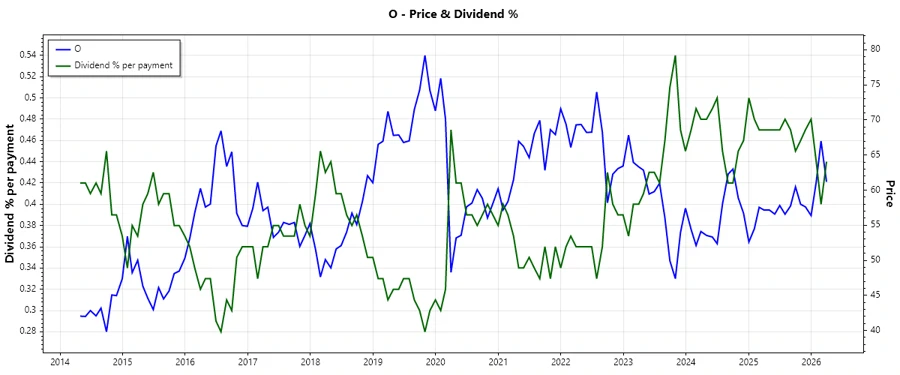
Realty Income Corporation, known for its stability, provides investors with a reliable dividend profile. With a current dividend yield over 5% and a steady history of 33 years of dividend payments, it’s a strong option for income-focused investors. The absence of recent dividend cuts enhances its reputation for consistency.
🗣️ Overview
Realty Income Corporation operates in the Real Estate sector, offering a substantial dividend yield of 5.29%. The current dividend per share stands at 3.23 USD, with an impressive track record of continuous increases over 33 years. Notably, there have been no recent dividend cuts or suspensions, underscoring its commitment to dividend reliability.
| Factor | Details |
|---|---|
| Sector | Real Estate |
| Dividend yield | 5.29% |
| Current dividend per share | 3.23 USD |
| Dividend history | 33 years |
| Last cut or suspension | None |
📈 Dividend History
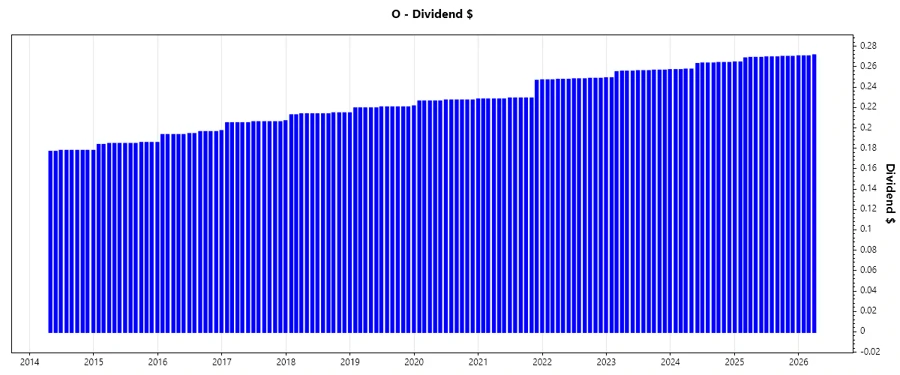
Realty Income’s dividend history showcases its long-standing commitment to distributing income to shareholders. This reliability is key for investors seeking stable income streams.
| Year | Dividend Per Share (USD) |
|---|---|
| 2026 | 0.811 |
| 2025 | 3.487 |
| 2024 | 2.869 |
| 2023 | 3.059 |
| 2022 | 2.969 |
🔼 Dividend Growth
A key driver of long-term returns, dividend growth at Realty Income is modest yet consistent. It emphasizes the company’s ongoing ability to improve shareholder returns over time.
| Time | Growth |
|---|---|
| 3 years | 5.51% |
| 5 years | 5.12% |
The average dividend growth is 5.12% over 5 years. This shows moderate but steady dividend growth.
⚖️ Payout Ratio
Payout ratios provide insight into dividend sustainability. Realty Income’s EPS-based payout ratio is 275.92%, reflecting its REIT structure, while the FCF-based ratio is a more sustainable 77.92%.
| Key Figure | Ratio |
|---|---|
| EPS-based | 275.92% |
| Free cash flow-based | 77.92% |
While the EPS-based payout ratio seems high, typical for REITs, the FCF-based ratio is reasonable, indicating better alignment with cash flow generation.
🧮 Cashflow & Capital Efficiency
Essential for assessing financial health, Realty Income’s ability to generate free cash flow and optimize capital allocation impacts its dividend resilience.
| Factor | 2023 | 2024 | 2025 |
|---|---|---|---|
| Free Cash Flow Yield | 6.48% | 7.40% | 7.57% |
| Earnings Yield | 2.19% | 1.85% | 2.08% |
| CAPEX to Operating Cash Flow | 2.32% | 3.40% | 3.30% |
| Stock-based Compensation to Revenue | 0.64% | 1.09% | 0% |
| Free Cash Flow / Operating Cash Flow Ratio | 97.68% | 96.60% | 96.70% |
The cash flow stability is solid, with a high free cash flow yield indicating effective capital utilization.
🏦 Balance Sheet & Leverage Analysis
Balance sheet strength is pivotal for financial stability and handling economic fluctuations. Realty Income’s ratios reflect moderate leverage.
| Factor | 2023 | 2024 | 2025 |
|---|---|---|---|
| Debt-to-Equity | 0.67 | 0.69 | 0.83 |
| Debt-to-Assets | 0.38 | 0.39 | 0.45 |
| Debt-to-Capital | 0.40 | 0.41 | 0.45 |
| Net Debt to EBITDA | 6.04 | 6.08 | 9.13 |
| Current Ratio | 1.53 | 1.68 | 0.51 |
| Quick Ratio | 1.52 | 1.68 | 0.51 |
| Financial Leverage | 1.75 | 1.77 | 1.85 |
The increasing debt ratios warrant caution, though they remain manageable within the REIT sector benchmarks.
🌟 Fundamental Strength & Profitability
Realized through ratios like Return on Equity and margins, these figures illustrate Realty Income’s operational effectiveness.
| Factor | 2023 | 2024 | 2025 |
|---|---|---|---|
| Return on Equity | 2.65% | 2.22% | 2.68% |
| Return on Assets | 1.51% | 1.25% | 1.45% |
| Net Margin | 21.39% | 16.33% | 18.41% |
| EBIT Margin | 41.87% | 36.65% | 18.76% |
| EBITDA Margin | 88.33% | 82.10% | 61.76% |
| Gross Margin | 92.23% | 92.83% | 89.80% |
| R&D to Revenue | 0% | 0% | 0% |
These robust profitability metrics underpin Realty Income’s steady dividend and potential for sustained shareholder value creation.
💹 Price Development
🏆 Dividend Scoring System
| Category | Score | Score Bar |
|---|---|---|
| Dividend Yield | 5 | |
| Dividend Stability | 5 | |
| Dividend Growth | 3 | |
| Payout Ratio | 2 | |
| Financial Stability | 3 | |
| Dividend Continuity | 5 | |
| Cashflow Coverage | 4 | |
| Balance Sheet Quality | 3 |
Total Score: 30/40
✅ Rating
Realty Income Corporation receives a strong dividend rating for its robust yield and stable history. The high payout ratio, typical for a REIT, and solid financial metrics reinforce its investment viability for income-focused portfolios. Investors might consider its moderate growth and leverage when assessing overall risks and opportunities.
Smart Data Insight
Master the Perfect Entry & Exit for this Stock
Don't leave your profits to chance. Historically, this stock follows specific seasonal patterns that institutional traders use to maximize returns.
- ✅ Identify the "Golden Buying Window"
- ✅ Avoid high-risk correction cycles
- ✅ Backtested data from the last 20+ years