
February 24, 2026 a 09:00 am

O: Analysts Ratings - Realty Income Corporation
Realty Income Corporation, known for its reliable monthly dividends supported by its real estate holdings, currently presents a mixed but evolving sentiment among analysts. While the company's reputation as a Dividend Aristocrat supports investor confidence, recent trends suggest a shift towards more conservative ratings. This may reflect broader market uncertainties or specific concerns about Realty Income's sector dynamics.
Historical Stock Grades
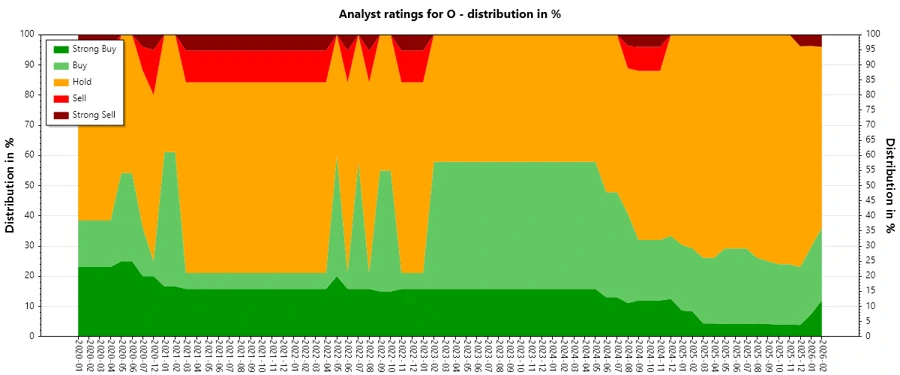
As of February 2026, analyst ratings for Realty Income Corporation reflect a cautious stance. Notably, the number of "Hold" ratings remains the majority, while there's a decline in "Strong Buy" and "Buy" ratings, suggesting a shift towards conservatism among analysts.
| Rating | Count | Score |
|---|---|---|
| Strong Buy | 3 | |
| Buy | 6 | |
| Hold | 15 | |
| Sell | 0 | |
| Strong Sell | 1 |
Sentiment Development
Over the past months, Realty Income's analyst sentiment has leaned increasingly toward "Hold" recommendations. This trend underscores a cautious approach by analysts, potentially driven by broader economic factors or specific developments within the company.
- Overall analyst recommendation count has remained relatively stable.
- A visible increase in "Hold" ratings from 12 in late 2024 to 15 by early 2026.
- Reduction in "Buy" and "Strong Buy" ratings suggests hesitancy in fresher investment commitments.
Percentage Trends
Recent data shows a significant percentage shift from "Buy" to "Hold" ratings, indicating increased analyst caution regarding the Realty Income stock. While the "Strong Buy" category has maintained a low profile, the rise in "Hold" ratings highlights a shift from earlier enthusiasm toward more reserved expectations.
- Increased percentage of "Hold" ratings from around 40% to 65% in the past year.
- Decrease in "Strong Buy" percentages from about 13% to 8%, showcasing diminished aggressive bullish sentiment.
- This adjustment marks a shift toward assessing sustainability and risk, rather than aggressive growth prospects.
Latest Analyst Recommendations
Recent analyst activities reveal a variety of decision-making trends. While some firms have maintained their previous ratings, others have adjusted their stance in line with changing market conditions or internal assessments of Realty Income’s prospects.
| Date | New Recommendation | Last Recommendation | Publisher |
|---|---|---|---|
| 2026-02-02 | Sector Outperform | Sector Perform | Scotiabank |
| 2025-12-24 | Equal Weight | Equal Weight | Morgan Stanley |
| 2025-12-18 | Underweight | Neutral | JP Morgan |
| 2025-12-17 | Neutral | Neutral | Mizuho |
| 2025-12-03 | Equal Weight | Equal Weight | Barclays |
Analyst Recommendations with Change of Opinion
The changes in analyst recommendations reveal slight variances in analyst opinion, often influenced by broader market factors or internal evaluations. Such shifts demonstrate a dynamic approach to ongoing market assessments.
| Date | New Recommendation | Last Recommendation | Publisher |
|---|---|---|---|
| 2026-02-02 | Sector Outperform | Sector Perform | Scotiabank |
| 2025-12-18 | Underweight | Neutral | JP Morgan |
| 2025-07-15 | Peer Perform | Outperform | Wolfe Research |
| 2024-11-14 | Neutral | Outperform | Mizuho |
| 2023-12-13 | Outperform | Neutral | Exane BNP Paribas |
Interpretation
Analyzing the recent analyst recommendations suggests a cautious market view towards Realty Income Corporation. The prevalence of "Hold" ratings indicates uncertainty or stabilization, while fewer upgrades or strong buys point to more reserved market expectations. However, the company's consistent dividend history provides a cushion of investor confidence.
Conclusion
Realty Income Corporation continues to command respect for its stable dividend yield, yet analyst sentiment has trended towards caution amid market dynamics. The increase in "Hold" ratings suggests analyst reservations about vigorous growth, demanding a nuanced risk-reward assessment. Investors should weigh the steadfast dividend history against potential headwinds in the real estate market and broader economic factors. In essence, Realty Income remains a dependable income-focused investment, though possibly facing near-term challenges reflected in shifts toward more conservative analyst stances.