
June 10, 2026 a 04:28 am

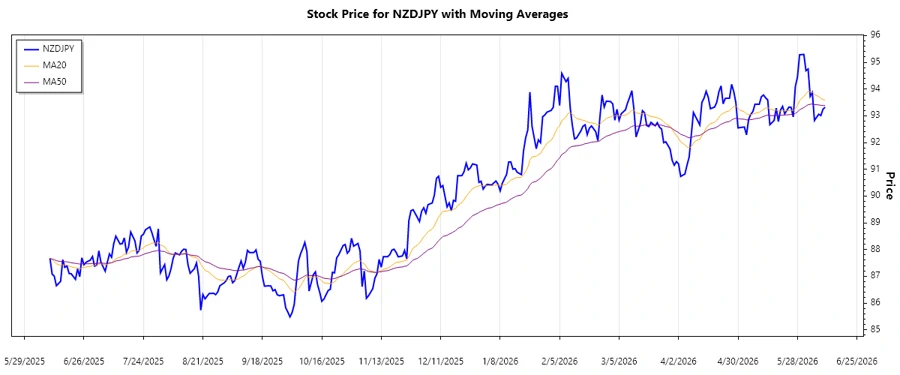

NZDJPY: Trend and Support & Resistance Analysis
The NZDJPY currency pair has shown dynamic movement over the past months. By analyzing recent price actions, we can detect a prevailing trend and key levels which are crucial for future price action. Identifying trends such as an upward or downward momentum helps traders make informed decisions. Examining support and resistance zones further equips traders with insights into potential reversal points or breakout levels.
Trend Analysis
Based on the recent data, we analyze the NZDJPY currency by examining its 20-day and 50-day Exponential Moving Averages (EMAs). The comparison between EMA20 and EMA50 allows us to determine the existing trend type.
| Date | Close Price | Trend |
|---|---|---|
| 2026-06-03 | 93.726 | ▲ |
| 2026-06-04 | 93.868 | ▲ |
| 2026-06-05 | 92.825 | ▼ |
| 2026-06-07 | 93.06 | ▲ |
| 2026-06-08 | 93.01 | ▼ |
| 2026-06-09 | 93.242 | ⚖️ |
| 2026-06-10 | 93.32 | ▲ |
The recent data suggests a combination of both uptrends and downtrends with EMA20 crossing EMA50, indicating potential upward momentum.
Support and Resistance
By evaluating support and resistance levels, traders gain insights into potential price reversal zones or breakout targets. These levels are pivotal in deciding entry and exit points:
| Zone Type | Low | High |
|---|---|---|
| Support Zone | 92.30 | 92.70 |
| Support Zone | 91.80 | 92.20 |
| Resistance Zone | 94.00 | 94.50 |
| Resistance Zone | 95.00 | 95.50 |
The recent price of 93.32 is within the resistance zone, indicating potential selling pressure if the price encounters this level.
Conclusion
The NZDJPY currency pair currently shows signs of upward pressure as indicated by the EMA trends. This suggests that traders should be on the lookout for potential breakouts at the defined resistance zones. Likewise, support levels can act as safety nets in case of downward price corrections. Maintaining awareness of these zones will be vital for trading strategies, ensuring that analysts prepare for both market rises and potential pullbacks.
Smart Data Insight
Master the Perfect Entry & Exit for this Stock
Don't leave your profits to chance. Historically, this stock follows specific seasonal patterns that institutional traders use to maximize returns.
- ✅ Identify the "Golden Buying Window"
- ✅ Avoid high-risk correction cycles
- ✅ Backtested data from the last 20+ years