
June 26, 2026 a 04:28 am

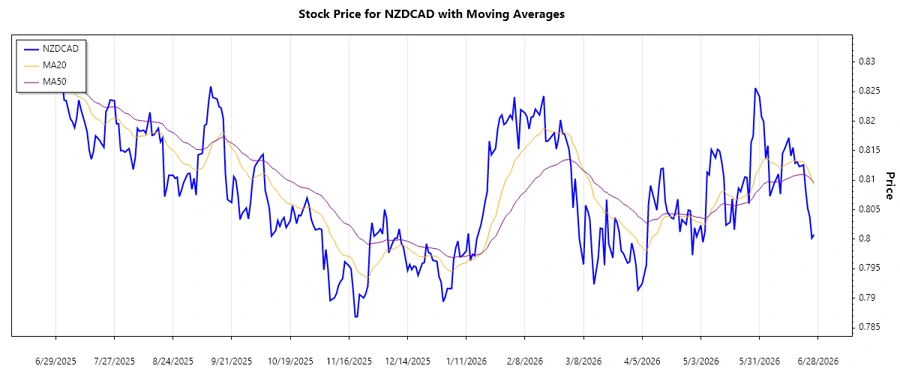

NZDCAD: Trend and Support & Resistance Analysis
The current analysis of NZDCAD currency pair shows a mixed trend characterized by short-term fluctuations. Technical indicators suggest a varied price movement in response to fundamental factors. Market participants should pay attention to support and resistance levels as these zones are critical for decision making.
Trend Analysis
The recent price data for NZDCAD shows intermittent price movements with minor fluctuations. By calculating the Exponential Moving Averages (EMAs) for 20 and 50 days, we observe the following trend:
| Date | Closing Price | Trend |
|---|---|---|
| 2026-06-26 | 0.80079 | ▲ Upward |
| 2026-06-25 | 0.80019 | ▼ Downward |
| 2026-06-24 | 0.80379 | ▲ Upward |
| 2026-06-23 | 0.80525 | ▲ Upward |
| 2026-06-22 | 0.80852 | ▲ Upward |
| 2026-06-21 | 0.81257 | ▲ Upward |
| 2026-06-19 | 0.8123 | ⚖️ Neutral |
The EMA analysis suggests a general upward trend, but with caution, as shorter-term EMAs show interspersed neutral or downward movement. The market seems to react to external pressures rapidly.
Support and Resistance
A close observation of price behavior reveals important support and resistance zones.
| Zone Type | Zone Range |
|---|---|
| Support 1 | 0.795 - 0.800 |
| Support 2 | 0.790 - 0.795 |
| Resistance 1 | 0.810 - 0.815 |
| Resistance 2 | 0.820 - 0.825 |
Currently, the price hovers around the resistance zone, suggesting potential downward pressure or a strong test of this level. A breakout above this resistance could signal stronger upward momentum.
Conclusion
The NZDCAD has shown a slight bullish indication recently, with resistance being a potential challenge for further upward momentum. Traders should monitor key support levels for breakdown signals. Minor fluctuations can be expected, driven by external economic conditions, requiring adaptive strategies. Sustaining above resistance levels would reflect market confidence, but potential dips may persuade a bearish outlook.
Smart Data Insight
Master the Perfect Entry & Exit for this Stock
Don't leave your profits to chance. Historically, this stock follows specific seasonal patterns that institutional traders use to maximize returns.
- ✅ Identify the "Golden Buying Window"
- ✅ Avoid high-risk correction cycles
- ✅ Backtested data from the last 20+ years