
February 07, 2026 a 04:03 am

INTU: Trend and Support & Resistance Analysis - Intuit Inc.
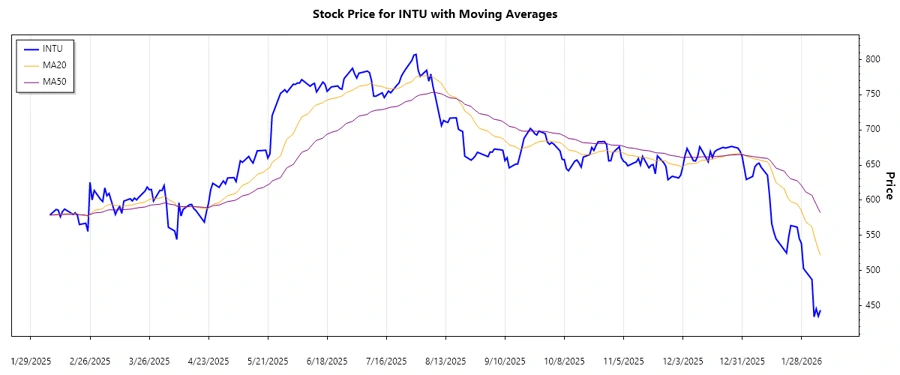
Intuit Inc., a powerhouse in financial management and compliance products, shows fluctuating stock movements over recent months. With varied demand across its segments—ranging from small business solutions to personal finance—the company's stock exhibits significant volatility. Analyzing recent trends and identifying key support and resistance zones provide a clearer picture of future performance potential. This technical evaluation serves as a critical tool for investors contemplating their position in this evolving market.
Trend Analysis
| Date | Close Price | Trend |
|---|---|---|
| 2026-02-06 | 443.77 | ▼ |
| 2026-02-05 | 434.91 | ▼ |
| 2026-02-04 | 445.64 | ▼ |
| 2026-02-03 | 434.09 | ▼ |
| 2026-02-02 | 487.12 | ▼ |
| 2026-01-30 | 498.92 | ▼ |
| 2026-01-29 | 502.98 | ▼ |
The data reveals a significant downward trend in the recent period, highlighted by the EMA20 consistently trailing below the EMA50. This suggests a period of weakness in the stock's price, indicative of bearish sentiment among investors. As a result, technical analysts may be cautious about immediate upward potential without clear reversal signals.
Support and Resistance
| Zone Type | From | To |
|---|---|---|
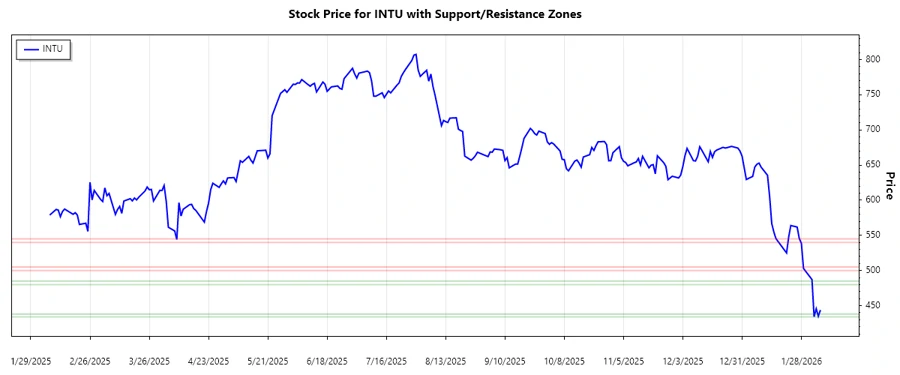
| Support 1 | 434 | 438 |
| Support 2 | 480 | 485 |
| Resistance 1 | 500 | 505 |
| Resistance 2 | 540 | 545 |
The current price is fluctuating around the first support zone (434-438), signifying potential buyer interest at these levels. The outlook remains cautious as breaking below this support could indicate further declines. However, any rebound with consistent volume could target the resistance levels, highlighting strategic entry points.
Conclusion
The technical analysis of Intuit Inc.'s stock reveals a prevailing bearish trend, with recent close prices consistently hitting lower lows. While key support zones may halt or reverse the decline, the prevailing market sentiment appears cautious. For investors, significant upside opportunities may be limited without substantial positive triggers, though value may be found at lower price bands. A tight stop-loss strategy could be prudent for short-term trading positions, given the prevailing market volatility.