
February 09, 2026 a 04:28 am

GBPCAD: Trend and Support & Resistance Analysis
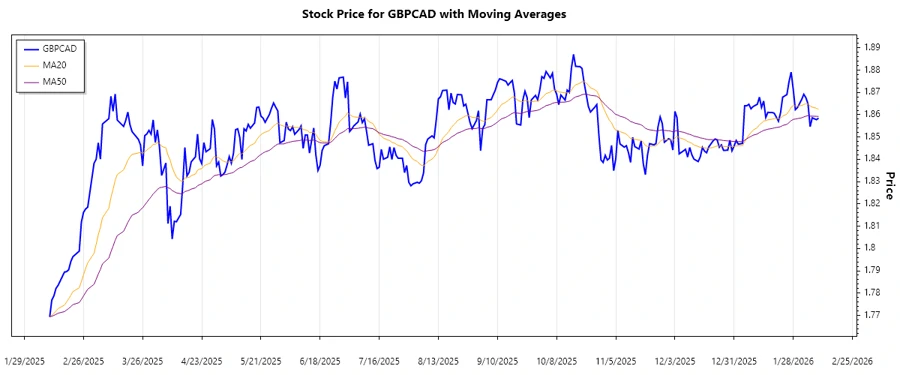
The GBPCAD currency pair has shown significant fluctuations over the past few months. As per the analyzed data, the trend reveals dynamic shifts, hinting at both potential opportunities for traders and inherent volatility risks. By evaluating moving averages and price movements, key insights can be derived for future trading strategies.
Trend Analysis
Analyzing the daily closing prices of the GBPCAD currency pair, the exponential moving averages (EMAs) provide clear indications of the current trend. The EMA20 and EMA50 calculations show that this currency pair experienced slight fluctuations, without a definitive dominant trend. The trend data over the latest period suggests a complex pattern with potential transitional phases.
| Date | Closing Price | Trend |
|---|---|---|
| 2026-02-09 | 1.8585 | ⚖️ |
| 2026-02-08 | 1.85777 | ⚖️ |
| 2026-02-06 | 1.85861 | ⚖️ |
| 2026-02-05 | 1.85465 | ⚖️ |
| 2026-02-04 | 1.86483 | ⚖️ |
| 2026-02-03 | 1.86762 | ▲ |
| 2026-02-02 | 1.86917 | ▲ |
In essence, the last observations show a balanced movement of GBPCAD, indicating no single direction. The potential presence of minor upward reversals suggests a necessity for careful monitoring.
Support and Resistance
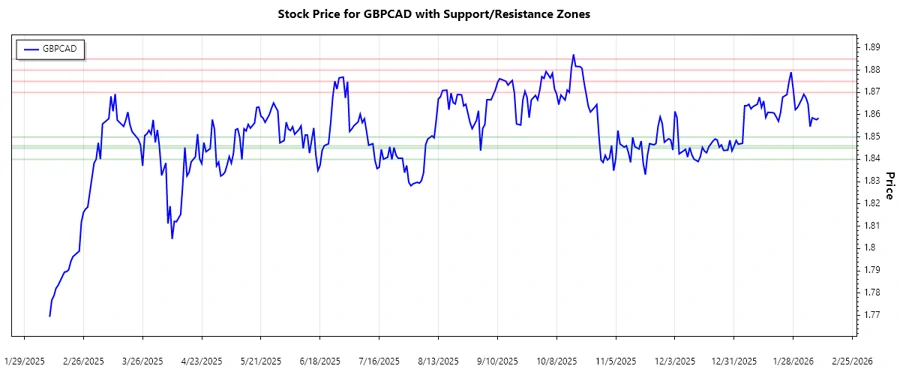
Based on the historical price data, the following support and resistance zones have been identified for GBPCAD.
| Zone Type | From | To |
|---|---|---|
| Support Zone 1 | 1.846 | 1.850 |
| Support Zone 2 | 1.840 | 1.845 |
| Resistance Zone 1 | 1.870 | 1.875 |
| Resistance Zone 2 | 1.880 | 1.885 |
As of the closing price on the last trading day, GBPCAD is currently hovering near the upper spectrum of a support zone, which might signal a buying opportunity for those expecting a rebound.
Conclusion
In conclusion, while the current trend of GBPCAD lacks a dominant direction, the currency pair remains close to significant support and resistance thresholds. This indicates potential trading opportunities both for bullish and bearish outlooks depending on forthcoming market data. While the presence near support might attract buyers, it's essential for traders to remain attentive to potential market shifts.