
May 01, 2026 a 04:28 am

EURJPY: Trend and Support & Resistance Analysis
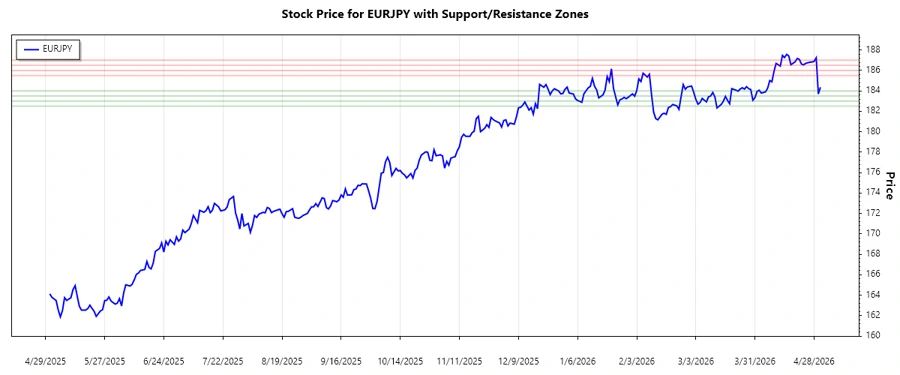
The EURJPY currency pair has shown significant volatility over the past months, reflecting fluctuating investor sentiment amid varying economic indicators from the Eurozone and Japan. Based on the recent technical analysis, we can observe the formation of certain trends and potential support and resistance zones that might be critical in guiding future price movements. Investors should remain cautious and watch for any fundamental changes that could impact these technical setups.
Trend Analysis
Analyzing the recent price movements of EURJPY, we calculated the Exponential Moving Averages (EMA) for 20 and 50 days to determine the prevailing trend. The EMA20 is currently higher than the EMA50, indicating a ▲ potential uptrend in recent days. Below is the trend for the last seven days:
| Date | Close Price | Trend |
|---|---|---|
| 2026-05-01 | 184.353 | ▲ |
| 2026-04-30 | 183.7 | ▲ |
| 2026-04-29 | 187.236 | ▲ |
| 2026-04-28 | 186.89 | ▲ |
| 2026-04-27 | 186.828 | ▲ |
| 2026-04-26 | 186.808 | ▲ |
| 2026-04-24 | 186.693 | ▲ |
The upward crossover of the shorter EMA over the longer EMA supports a bullish outlook. This indicates potential buying pressure and a recommended long position for the time being.
Support and Resistance
Identifying critical support and resistance levels can provide insights into potential price stoppages or reversals. Based on recent closing prices, the following support and resistance zones are identified:
| Zone Type | From | To |
|---|---|---|
| Support 1 | 183.50 | 184.00 |
| Support 2 | 182.50 | 183.00 |
| Resistance 1 | 186.50 | 187.00 |
| Resistance 2 | 185.50 | 186.00 |
Currently, the EURJPY is trading just above the Support 1 level, indicating potential buy entries upon successful support confirmation. However, vigilance for trend reversals at resistance levels is advised.
Conclusion
In summary, the EURJPY is presently exhibiting a bullish tendency, which is corroborated by the EMA trend analysis. Investors should be mindful of the identified support and resistance zones, as they present potential areas for price reversals or continuations. While the technical data suggests a positive bias, external macroeconomic elements should also be factored into decision-making processes. Short-term opportunities might exist if the uptrend continues, but caution remains essential due to potential volatility. Overall, the market sentiment appears to favor euro strength against the yen, barring unforeseen changes in economic indicators.