
February 11, 2026 a 05:08 am
EURAUD: Fibonacci Analysis
The EURAUD currency pair has shown significant volatility in recent months, with evident price shifts indicating distinct trends. Investors should be aware of changing economic indicators in both the Eurozone and Australia, which can impact this exchange rate. As global economic conditions fluctuate, so too does the stability of EURAUD, presenting opportunities and risks for traders.
Fibonacci Analysis
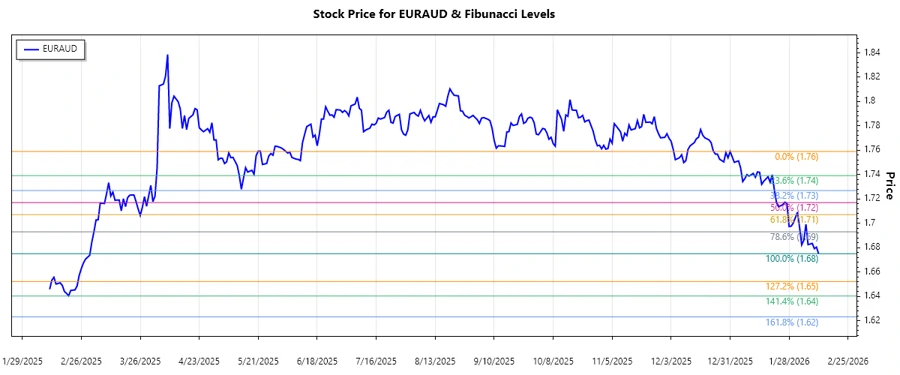
The EURAUD experienced a dominant downtrend from late December 2025 to early February 2026. The highest price was noted on December 31, 2025, at 1.75898, while the lowest occurred on February 11, 2026, at 1.675. Using these points, we compute the Fibonacci retracement levels to understand potential support and resistance areas.
| Aspect | Details |
|---|---|
| Start Date | 2025-12-31 |
| End Date | 2026-02-11 |
| High Price | 1.75898 (2025-12-31) |
| Low Price | 1.675 (2026-02-11) |
| Fibonacci Levels |
|
| Current Price Analysis | The current price is close to the 0.382 retracement level, indicating a possible resistance zone. |
| Technical Interpretation | This Fibonacci retracement suggests that the EURAUD may face resistance near the 0.382 level, potentially acting as a barrier for upward momentum. |
Conclusion
In conclusion, the recent downtrend in EURAUD suggests that traders should remain cautious of potential resistance levels as indicated by Fibonacci retracement analysis. The currency pair's proximity to the 0.382 level implies that any upward movement might face significant pressure. This technical insight allows analysts to prepare for short-term resistance while considering the impacts of broader economic changes between the Eurozone and Australia. The presence of resistance may provide trading opportunities or necessitate protective action depending on market reactions. Overall, while potential gains exist, so do the risks associated with currency trading in such volatile market conditions.