
March 09, 2026 a 09:03 am

DUK: Trend and Support & Resistance Analysis - Duke Energy Corporation
Duke Energy Corporation (DUK) has been showing a consistent upward trend, driven by its diversified energy operations and expanding customer base in key U.S. markets. The technical indicators, including moving averages, confirm this upward momentum. However, investors should be aware of potential environmental regulations affecting the energy sector, which could impact future growth. The current price levels suggest importance at the mentioned support and resistance zones, providing opportunities for strategic entries and exits.
Trend Analysis
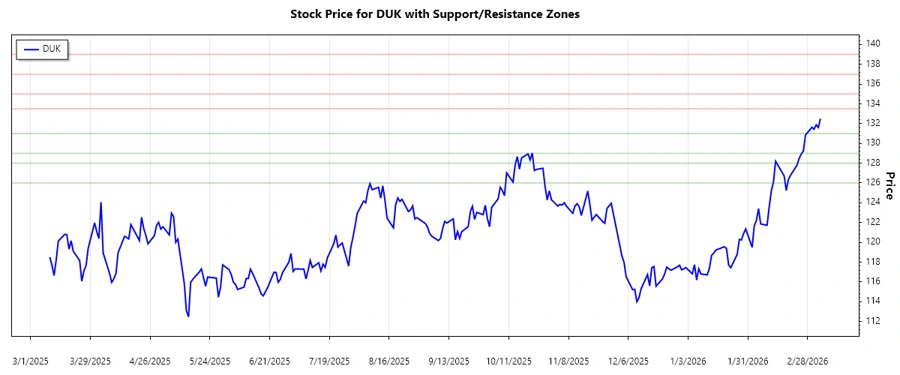
The analysis of Duke Energy's stock for the past months indicates a notable upward trend. The recent data points to an increase in the stock price, with the calculated EMA20 (Exponential Moving Average for 20 days) surpassing the EMA50, indicating a continuous rise. Below is the table of recent trends:
| Date | Close Price | Trend |
|---|---|---|
| 2026-03-06 | 132.50 | ▲ |
| 2026-03-05 | 131.61 | ▲ |
| 2026-03-04 | 131.88 | ▲ |
| 2026-03-03 | 131.43 | ▲ |
| 2026-03-02 | 131.63 | ▲ |
| 2026-02-27 | 130.85 | ▲ |
| 2026-02-26 | 129.23 | ▲ |
Conclusively, Duke Energy's stock demonstrates a strong bullish signal, as indicated by the EMA trend. The consistently rising prices strengthen the confidence in a potential long-term positive performance.
Support and Resistance
Upon scrutinizing recent price movements, we've identified key support and resistance zones crucial for traders and investors. The calculated levels point to important technical zones:
| Zone Type | From | To |
|---|---|---|
| Support | 129.00 | 131.00 |
| Support | 126.00 | 128.00 |
| Resistance | 133.50 | 135.00 |
| Resistance | 137.00 | 139.00 |
Currently, the stock price of Duke Energy is situated slightly below a major resistance zone, offering a potential selling point for short-term traders. Understanding these zones supports better timing for strategic decisions in buying or selling positions.
Conclusion
Duke Energy's prospects appear promising, marked by an upward trend and defined support/resistance zones. The primary risk lies in the evolving energy sector regulations, which could influence profitability. Nonetheless, the company’s diversified operations across electric and gas utilities offer stability. The ongoing trend suggests buying opportunities for long-term growth, while the proximity to resistance levels is also a call for strategic caution in acquisitions. For analysts, this environment presents both opportunities and challenges in the stock’s valuation.