
May 24, 2026 a 07:31 am
DUK: Dividend Analysis - Duke Energy Corporation
Duke Energy Corporation, a stalwart in the utility sector, offers investors a consistent and reliable dividend income. With a historical dividend presence spanning over four decades, the company demonstrates a commitment to returning value to shareholders. While its dividend growth is modest, the stability of its payouts coupled with a strong market cap showcases its potential as a steady investment in income-focused portfolios.
📊 Overview
| Metric | Value |
|---|---|
| Sector | Utilities |
| Dividend yield | 3.52 % |
| Current dividend per share | 4.25 USD |
| Dividend history | 44 years |
| Last cut or suspension | None |
🗣️ Dividend History
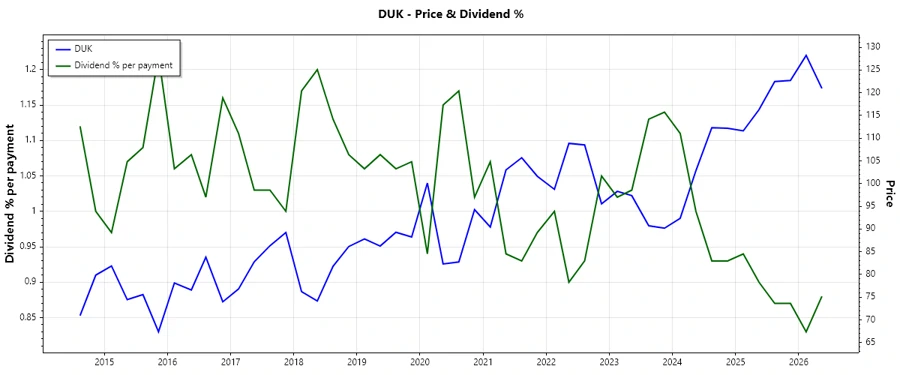
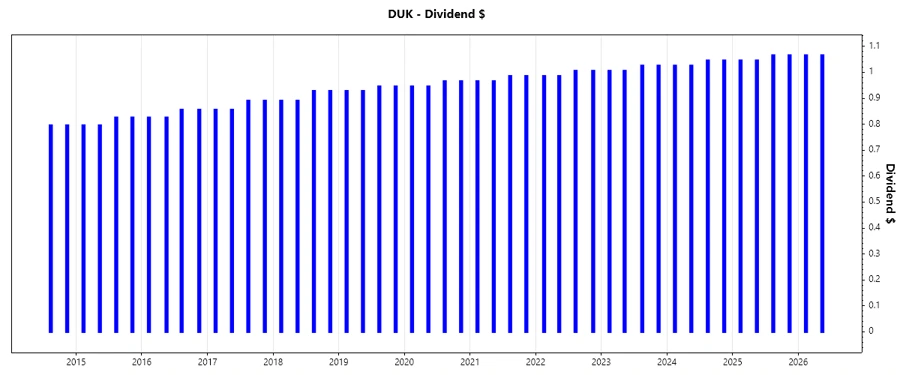
Duke Energy has maintained a robust dividend history for 44 years, signaling reliability and trust to its investors. Historical dividend payments illustrate a steady increase, important for long-term income stability and growth.
| Year | Dividend per Share (USD) |
|---|---|
| 2026 | 2.13 |
| 2025 | 4.22 |
| 2024 | 4.14 |
| 2023 | 4.06 |
| 2022 | 3.98 |
📈 Dividend Growth
While the growth rate of Duke Energy's dividends has been modest over the past few years, this steady increase, averaging 2% over five years, highlights the firm's commitment to enhancing shareholder value.
| Time | Growth |
|---|---|
| 3 years | 2.00 % |
| 5 years | 2.01 % |
The average dividend growth is 2.01 % over 5 years. This shows moderate but steady dividend growth.
✅ Payout Ratio
The payout ratio is a critical measure of dividend sustainability. Duke Energy's EPS based payout ratio of 64.30 % and FCF based payout ratio of 50.14 % reflect a balanced and sustainable dividend policy.
| Key figure | Ratio |
|---|---|
| EPS-based | 64.30 % |
| Free cash flow-based | 50.14 % |
📊 Cashflow & Capital Efficiency
Efficient capital and cash flow management are vital for operational stability and growth investments. Duke Energy maintains a positive free cash flow and earnings yield, highlighting its ability to generate adequate capital from operations to cover dividends and reinvest for future growth.
| Metric | Year 2025 | Year 2024 | Year 2023 |
|---|---|---|---|
| Free Cash Flow Yield | -1.84% | 0.06% | -3.64% |
| Earnings Yield | 5.45% | 5.42% | 5.74% |
| CAPEX to Operating Cash Flow | 113.54% | 99.61% | 127.60% |
| Stock-based Compensation to Revenue | 0% | 0% | 0% |
| Free Cash Flow / Operating Cash Flow Ratio | -13.54% | 0.39% | -27.60% |
⚠️ Balance Sheet & Leverage Analysis
Analyze the leverage and financial structure to assess stability and risk. Duke Energy’s leverage ratios indicate a heavier reliance on debt financing, a typical characteristic of utility companies that benefit from stable cash flows.
| Metric | Year 2025 | Year 2024 | Year 2023 |
|---|---|---|---|
| Debt-to-Equity | 1.75 | 1.70 | 1.64 |
| Debt-to-Assets | 46.42% | 45.74% | 45.48% |
| Debt-to-Capital | 63.67% | 62.97% | 62.10% |
| Net Debt to EBITDA | 5.78 | 5.66 | 5.78 |
| Current Ratio | 0.55 | 0.67 | 0.74 |
| Quick Ratio | 0.33 | 0.44 | 0.49 |
📈 Fundamental Strength & Profitability
Duke Energy's profitability metrics point towards a robust financial performance, underlined by consistently positive returns on equity and assets. These indicators signal the firm’s effectiveness in managing its assets to generate profits.
| Metric | Year 2025 | Year 2024 | Year 2023 |
|---|---|---|---|
| Return on Equity | 9.58% | 9.00% | 8.75% |
| Return on Assets | 2.54% | 2.42% | 2.43% |
| Return on Invested Capital | 4.13% | 4.02% | 3.85% |
| Net Margin | 15.41% | 14.86% | 14.78% |
| EBIT Margin | 28.99% | 28.26% | 26.78% |
| EBITDA Margin | 48.61% | 49.40% | 47.71% |
| Gross Margin | 31.56% | 50.06% | 47.34% |
📉 Price Development
📊 Dividend Scoring System
| Category | Score (out of 5) | Score Bar |
|---|---|---|
| Dividend yield | 3 | |
| Dividend Stability | 4 | |
| Dividend growth | 2 | |
| Payout ratio | 3 | |
| Financial stability | 3 | |
| Dividend continuity | 5 | |
| Cashflow Coverage | 3 | |
| Balance Sheet Quality | 3 |
Overall Score: 26 out of 40
⭐ Rating
Duke Energy Corporation presents a solid option for dividend-oriented investors seeking reliability and stable income. While the growth rate is moderate, the stability and continuity of dividends make it a compelling choice for conservative portfolios. With a score of 26 out of 40, it remains a sound investment, primarily in times of economic uncertainty.
Smart Data Insight
Master the Perfect Entry & Exit for this Stock
Don't leave your profits to chance. Historically, this stock follows specific seasonal patterns that institutional traders use to maximize returns.
- ✅ Identify the "Golden Buying Window"
- ✅ Avoid high-risk correction cycles
- ✅ Backtested data from the last 20+ years