
December 10, 2025 a 07:31 am

CPB: Dividend Analysis - Campbell Soup Company
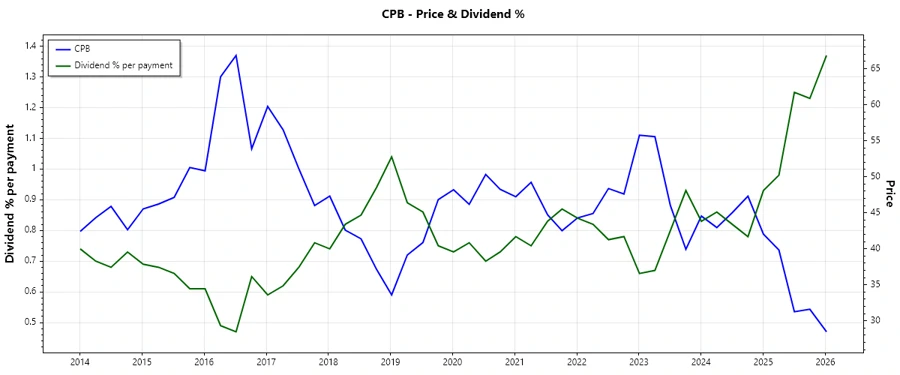
Campbell Soup Company presents a formidable dividend profile with a longstanding dividend history. Although facing a recent dividend cut, the company has maintained a consistent payout over the years, offering a noteworthy yield. The current metrics indicate a company with steady, albeit modest, growth potential.
📊 Overview
The company's dividend profile remains resilient, highlighted by its substantial 43-year dividend history. Despite the recent cut in 2026, the company offers a 5.48% yield, which is attractive in the consumer staples sector.
| Metric | Details |
|---|---|
| Sector | Consumer Staples |
| Dividend yield | 5.48 % |
| Current dividend per share | 1.54 USD |
| Dividend history | 43 years |
| Last cut or suspension | 2026 |
🗣️ Dividend History
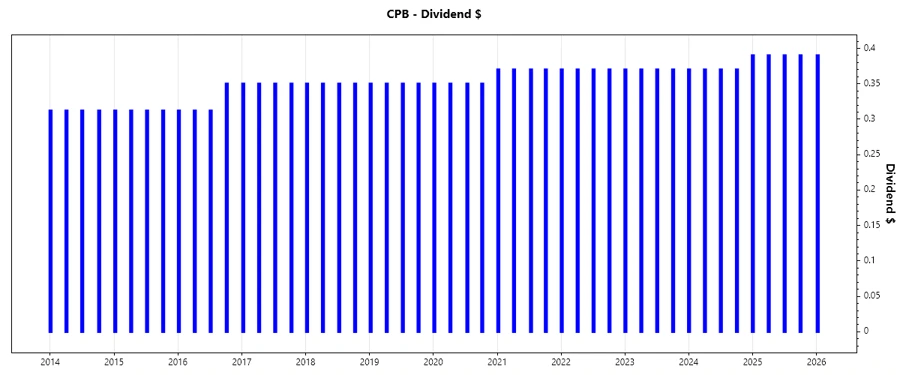
The steady dividend history is a testament to Campbell's commitment to returning value to shareholders. Historical stability in dividends is a key indicator of long-term financial solidity and operational strength.
| Year | Dividend Per Share (USD) |
|---|---|
| 2026 | 0.39 |
| 2025 | 1.56 |
| 2024 | 1.48 |
| 2023 | 1.48 |
| 2022 | 1.48 |
📈 Dividend Growth
Dividend growth reflects a company's capacity to increase shareholder returns over time. Despite recent stasis, Campbell's prior 5-year growth underscores moderate advancement.
| Time | Growth |
|---|---|
| 3 years | 0 % |
| 5 years | 1.12 % |
The average dividend growth is 1.12% over 5 years. This shows moderate but steady dividend growth.
✅ Payout Ratio
Payout ratios epitomize the sustainability of a company's dividend payments through earnings and free cash flow perspectives.
| Key figure | Ratio |
|---|---|
| EPS-based | 119.33 % |
| Free cash flow-based | 55.57 % |
High EPS-based payout ratio (119.33%) highlights concerns over earnings coverage, while FCF-based payout (55.57%) is within more reassuring levels.
💸 Cashflow & Capital Efficiency
Analyzing cash flow and capital efficiency provides insights into the firm’s ability to sustain and fund future operations.
| Metric | 2025 | 2024 | 2023 |
|---|---|---|---|
| Free Cash Flow Yield | 7.33% | 4.75% | 5.64% |
| Earnings Yield | 6.26% | 4.03% | 6.26% |
| CAPEX to Operating Cash Flow | 37.67% | 43.63% | 32.37% |
| Stock-based Compensation to Revenue | 0.56% | 1.03% | 0.67% |
| Free Cash Flow / Operating Cash Flow Ratio | 62.33% | 56.37% | 67.63% |
Consistent free cash flow yield underscores financial flexibility and sustainability of dividend payments, ensuring continued investor returns.
🏦 Balance Sheet & Leverage Analysis
A thorough assessment of balance sheet strength and leverage outlines a company's capacity to manage its debts and financial obligations.
| Metric | 2025 | 2024 | 2023 |
|---|---|---|---|
| Debt-to-Equity | 1.85 | 1.99 | 1.36 |
| Debt-to-Assets | 0.48 | 0.50 | 0.41 |
| Debt-to-Capital | 0.65 | 0.67 | 0.58 |
| Net Debt to EBITDA | 4.50 | 5.25 | 2.81 |
| Current Ratio | 0.77 | 0.61 | 0.93 |
| Quick Ratio | 0.28 | 0.22 | 0.35 |
| Financial Leverage | 3.82 | 4.02 | 3.29 |
Campbell upholds a moderate leverage profile, with improved metrics over time indicating increased financial stability.
💪 Fundamental Strength & Profitability
Analyzing profitability metrics elucidates the intrinsic earning power and operational competence of the enterprise.
| Metric | 2025 | 2024 | 2023 |
|---|---|---|---|
| Return on Equity | 15.43% | 14.94% | 23.44% |
| Return on Assets | 4.04% | 3.72% | 7.12% |
| Return on Invested Capital | 7.96% | 6.97% | 9.88% |
| Net Margin | 5.87% | 5.88% | 9.17% |
| EBIT Margin | 11.13% | 10.44% | 14.06% |
| EBITDA Margin | 15.36% | 14.71% | 18.20% |
| Gross Margin | 30.42% | 30.83% | 31.17% |
| R&D to Revenue | 0.98% | 1.06% | 0.98% |
Profitability metrics show robust returns, reflecting operationalness and core competency, supporting a reliable investment profile.
⚠️ Price Development
📊 Dividend Scoring System
The following is a subjective assessment of Campbell Soup Company's dividend endeavors, using a comprehensive scoring system.
| Category | Score | Rating |
|---|---|---|
| Dividend yield | 4 | |
| Dividend Stability | 2 | |
| Dividend growth | 2 | |
| Payout ratio | 3 | |
| Financial stability | 4 | |
| Dividend continuity | 3 | |
| Cashflow Coverage | 4 | |
| Balance Sheet Quality | 4 |
Overall Score: 26 out of 40
🎯 Rating
Campbell Soup Company exhibits solid dividend yield potential, albeit challenged by recent growth stasis. It maintains a strong presence in consumer staples, demonstrating resilient income opportunities for value-focused investors.
Smart Data Insight
Master the Perfect Entry & Exit for this Stock
Don't leave your profits to chance. Historically, this stock follows specific seasonal patterns that institutional traders use to maximize returns.
- ✅ Identify the "Golden Buying Window"
- ✅ Avoid high-risk correction cycles
- ✅ Backtested data from the last 20+ years