
December 28, 2025 a 02:47 am


CL: Dividend Analysis - Colgate-Palmolive Company
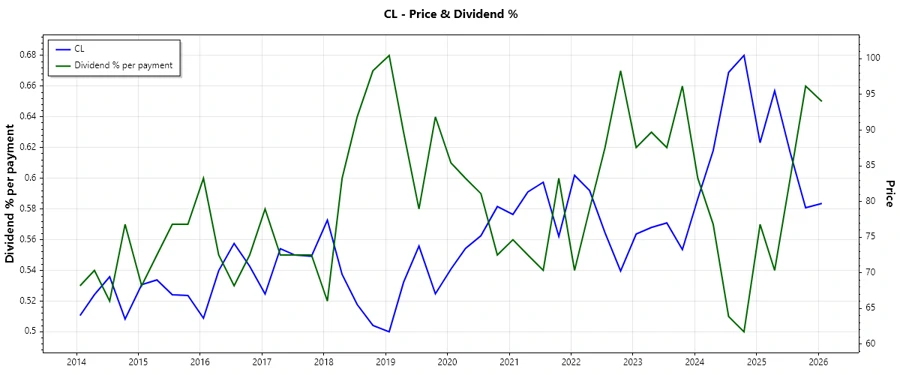
Colgate-Palmolive Company exhibits a remarkable track record in dividend distributions, boasting over five decades of consistent increases, though its recent payout ratio and modest growth rates call for scrutiny. An imperative analysis reveals a solid yield with a challenge in growth acceleration.
📊 Overview
Colgate-Palmolive operates within the Consumer Goods sector, contributing to the appeal of its dividend profile. It maintains a steady dividend yield of 2.61%, paired with a recent dividend per share of 2.19 USD. The company's 54-year history of dividend payouts remains a testament to its stability.
| Category | Detail |
|---|---|
| Sector | Consumer Goods |
| Dividend yield | 2.61% |
| Current dividend per share | 2.19 USD |
| Dividend history | 54 years |
| Last cut or suspension | 2026 |
📈 Dividend History
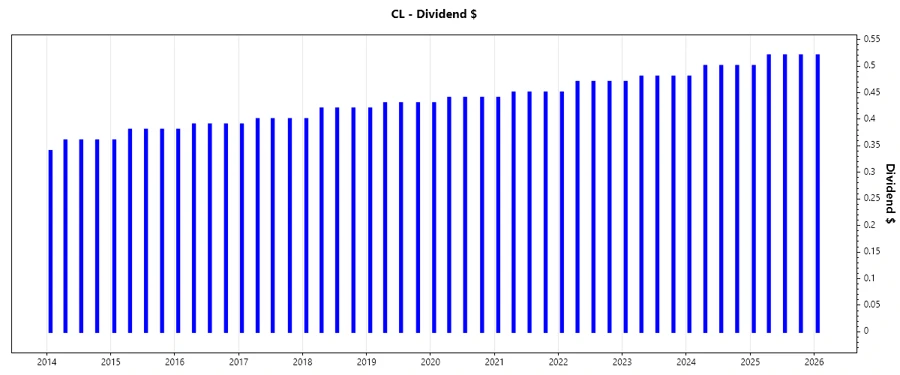
A robust dividend history is crucial in evaluating a company's commitment to returning value to shareholders. Colgate's continuation over 54 years reflects strong financial management.
| Year | Dividend per Share (USD) |
|---|---|
| 2026 | 0.52 |
| 2025 | 2.06 |
| 2024 | 1.98 |
| 2023 | 1.91 |
| 2022 | 1.86 |
📉 Dividend Growth
Monitoring dividend growth is essential for assessing future capital returns. With modest growth rates of 3.42% over 3 years and 2.98% over 5 years, the consistency parallels the company's long-term resilience.
| Time | Growth |
|---|---|
| 3 years | 3.42% |
| 5 years | 2.98% |
The average dividend growth is 2.98% over 5 years. This shows moderate but steady dividend growth.
Payout Ratio
Payout ratios elucidate how much of the company's earnings and free cash flow are directed towards dividends. The EPS-based payout stands at 60.80%, while free cash flow supports coverage at 51.23%.
| Key figure | Ratio |
|---|---|
| EPS-based | 60.80% |
| Free cash flow-based | 51.23% |
These payout ratios denote a sustainable dividend policy, although improvements in earnings growth could reinforce stability.
🗣️ Cashflow & Capital Efficiency
Evaluating cash flows and capital efficiency metrics reveals the company's ability to sustain operations, fund growth, and return capital through dividends.
| Metric | 2024 | 2023 | 2022 |
|---|---|---|---|
| Free Cash Flow Yield | 4.77% | 4.61% | 2.82% |
| Earnings Yield | 3.89% | 3.49% | 2.71% |
| CAPEX to Operating Cash Flow | 14.26% | 18.83% | 27.23% |
| Stock-based Compensation to Revenue | 0.68% | 0.63% | 0.70% |
| Free Cash Flow / Operating Cash Flow Ratio | 86.34% | 81.17% | 72.77% |
Analysis indicates strong capital efficiency, though higher CAPEX ratios merit attention to sustain long-term efficiencies.
Balance Sheet & Leverage Analysis
An examination of Colgate's balance sheet outlines the financial leverage and liquidity, ensuring capacity to cover obligations and fund investments.
| Ratio | 2024 | 2023 | 2022 |
|---|---|---|---|
| Debt-to-Equity | 40.15 | 14.88 | 23.12 |
| Debt-to-Assets | 53.05% | 55.29% | 58.93% |
| Debt-to-Capital | 97.57% | 93.70% | 95.85% |
| Net Debt to EBITDA | 1.53 | 1.91 | 2.52 |
| Current Ratio | 0.92 | 1.11 | 1.28 |
| Quick Ratio | 0.58 | 0.71 | 0.76 |
| Financial Leverage | 75.69 | 26.92 | 39.23 |
The data indicates robust leverage standings with noteworthy debt reductions over recent years, ensuring safeguards against fiscal vulnerabilities.
Fundamental Strength & Profitability
Fundamentals provide insight into operational efficiency and profit generation potential, critical for sustaining dividend policies.
| Metric | 2024 | 2023 | 2022 |
|---|---|---|---|
| Return on Equity | 13.63% | 3.78% | 4.45% |
| Return on Assets | 18.00% | 14.03% | 11.35% |
| Net Margin | 14.37% | 11.82% | 9.93% |
| EBIT Margin | 21.13% | 18.91% | 15.73% |
| EBITDA Margin | 24.14% | 21.82% | 18.77% |
| Gross Margin | 60.23% | 57.82% | 56.49% |
| Research & Development to Revenue | 1.77% | 1.76% | 1.78% |
These metrics signal consistent profit margins, supported by strategic research and development expenditures.
✅ Price Development
📈 Dividend Scoring System
| Criterion | Score | Rating |
|---|---|---|
| Dividend yield | 4 | |
| Dividend Stability | 5 | |
| Dividend growth | 3 | |
| Payout ratio | 4 | |
| Financial stability | 4 | |
| Dividend continuity | 5 | |
| Cashflow Coverage | 4 | |
| Balance Sheet Quality | 4 |
Overall Score: 33/40
🔍 Rating
Overall, Colgate-Palmolive maintains a formidable dividend presence, suitable for investors valuing income stability more than aggressive growth. Despite moderate payout flexibility, its resilience in adverse times underwrites a solid HOLD rating.
Smart Data Insight
Master the Perfect Entry & Exit for this Stock
Don't leave your profits to chance. Historically, this stock follows specific seasonal patterns that institutional traders use to maximize returns.
- ✅ Identify the "Golden Buying Window"
- ✅ Avoid high-risk correction cycles
- ✅ Backtested data from the last 20+ years