
March 14, 2026 a 07:31 am

BALL: Dividend Analysis - Ball Corporation
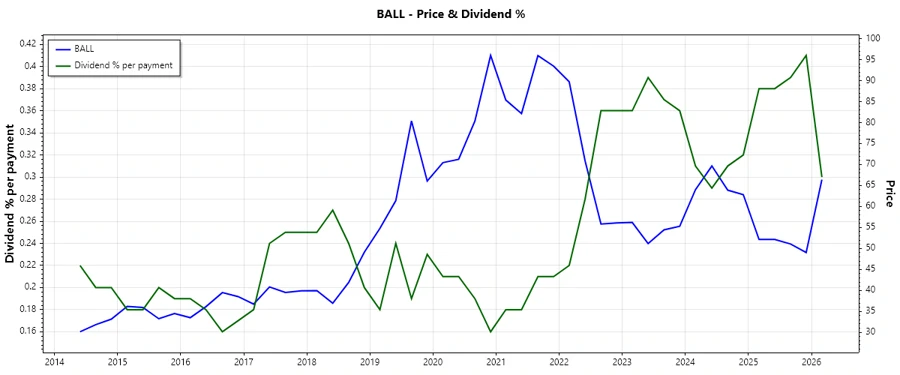
Ball Corporation has established itself as a consistent dividend-payer, maintaining an impressive track record over 42 years. With a dividend yield that modestly aligns with industry standards, it reflects consistent sizes of payouts and maintains healthy payout ratios. While recent years haven't shown significant dividend growth, the company's commitment to dividend continuity remains evident. Investors seeking stability and long-term returns may find Ball Corporation's dividend profile appealing.
📊 Overview
| Parameter | Details |
|---|---|
| Sector | Materials |
| Dividend Yield | 1.20 % |
| Current Dividend per Share | 0.80 USD |
| Dividend History | 42 years |
| Last Cut or Suspension | None |
🗣️ Dividend History
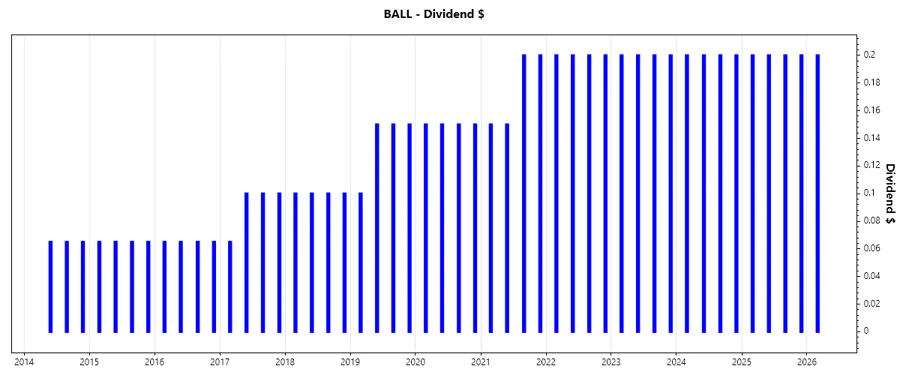
With 42 consecutive years of dividend payments, Ball Corporation demonstrates robust dividend continuity, crucial for income investors focused on safety and reliability. Consistent dividends underscore management's commitment to returning capital to shareholders, even amidst economic cycles.
| Year | Dividend per Share (USD) |
|---|---|
| 2026 | 0.20 |
| 2025 | 0.80 |
| 2024 | 0.80 |
| 2023 | 0.80 |
| 2022 | 0.80 |
📈 Dividend Growth
The dividend growth analysis highlights a lack of significant increases in recent years, implying a focus on maintaining stable payouts over aggressive growth. Consistent dividends can appeal to investors seeking dependable income.
| Time | Growth |
|---|---|
| 3 years | 0 % |
| 5 years | 5.92 % |
The average dividend growth is 5.92 % over 5 years. This shows moderate but steady dividend growth.
💰 Payout Ratio
Payout ratios are critical metrics suggesting financial stability and dividend sustainability. A low EPS-based ratio of 23.49 % and FCF-based ratio of 27.28 % signifies that Ball Corporation conservatively manages its earnings and free cash flow relative to dividends, leaving room for reinvestment and dividend increases.
| Key Figure | Ratio |
|---|---|
| EPS-based | 23.49 % |
| Free cash flow-based | 27.28 % |
⚖️ Cashflow & Capital Efficiency
Evaluating free cash flow yield and capital efficiency provides insight into the firm's ability to generate cash relative to its operations and capital investments. Ball Corporation's cash flow metrics suggest prudent management and sufficient liquidity for dividend sustainability.
| Key Metrics | 2025 | 2024 | 2023 |
|---|---|---|---|
| Free Cash Flow Yield | 5.42 % | -2.19 % | 4.52 % |
| Earnings Yield | 6.28 % | 23.80 % | 3.90 % |
| CAPEX to Operating Cash Flow | 37.56 % | 420.87 % | 56.09 % |
| Stock-based Compensation to Revenue | 0 % | 0 % | 0 % |
| Free Cash Flow / Operating Cash Flow Ratio | 62.44 % | -320.87 % | 43.91 % |
📉 Balance Sheet & Leverage Analysis
Understanding leverage ratios is essential for assessing financial risk and stability. Ball Corporation's balance sheet reflects significant leverage, yet manageable due to its ability to generate consistent cash flows.
| Ratios | 2025 | 2024 | 2023 |
|---|---|---|---|
| Debt-to-Equity | 1.29 | 1.03 | 2.27 |
| Debt-to-Assets | 35.91 % | 34.13 % | 44.39 % |
| Debt-to-Capital | 56.40 % | 50.65 % | 69.45 % |
| Net Debt to EBITDA | 2.77 | 3.51 | 4.47 |
| Current Ratio | 1.11 | 1.00 | 0.79 |
| Quick Ratio | 0.75 | 0.69 | 0.54 |
| Financial Leverage | 3.60 | 3.01 | 5.12 |
✅ Fundamental Strength & Profitability
Assessing profitability metrics reveals how effectively Ball Corporation utilizes its resources. Positive return metrics and sturdy margins indicate efficient operations, supporting long-term profitability and stable dividends.
| Key Metrics | 2025 | 2024 | 2023 |
|---|---|---|---|
| Return on Equity | 16.82 % | 68.37 % | 18.76 % |
| Return on Assets | 4.67 % | 22.74 % | 3.66 % |
| Net Margin | 6.93 % | 33.97 % | 5.88 % |
| EBIT Margin | 11.16 % | 7.11 % | 8.94 % |
| EBITDA Margin | 15.89 % | 12.37 % | 14.64 % |
| Gross Margin | 14.86 % | 15.59 % | 14.28 % |
| R&D to Revenue | 0 % | 0 % | 0.46 % |
📈 Price Development
🏆 Dividend Scoring System
| Criteria | Score | |
|---|---|---|
| Dividend Yield | 3 | |
| Dividend Stability | 5 | |
| Dividend Growth | 2 | |
| Payout Ratio | 4 | |
| Financial Stability | 3 | |
| Dividend Continuity | 5 | |
| Cashflow Coverage | 4 | |
| Balance Sheet Quality | 3 |
Total Score: 29/40
📢 Rating
Ball Corporation presents a solid dividend investment option, particularly for those valuing consistency and moderate growth. While dividend growth is limited, stability and a strong track record offer reliable income. For investors focused on income preservation and gradual growth, Ball Corporation remains a commendable inclusion in a diversified portfolio.