
February 01, 2026 a 02:47 am

BALL: Dividend Analysis - Ball Corporation
Ball Corporation has demonstrated a commitment to sustained dividends, reflected in its admirable 42 years of dividend history. With a moderate yield of approximately 1.41% and consistent payout, it appeals to conservative dividend investors. However, its high free cash flow payout ratio poses potential sustainability concerns. Overall, this company showcases a delicate balance between rewarding shareholders and maintaining financial stability.
📊 Overview
The overview provides essential insights into Ball Corporation's dividend viability and its strategic alignment within the sector.
| Metric | Value |
|---|---|
| Sector | Materials |
| Dividend yield | 1.41% |
| Current dividend per share | 0.80 USD |
| Dividend history | 42 years |
| Last cut or suspension | None |
🗣️ Dividend History
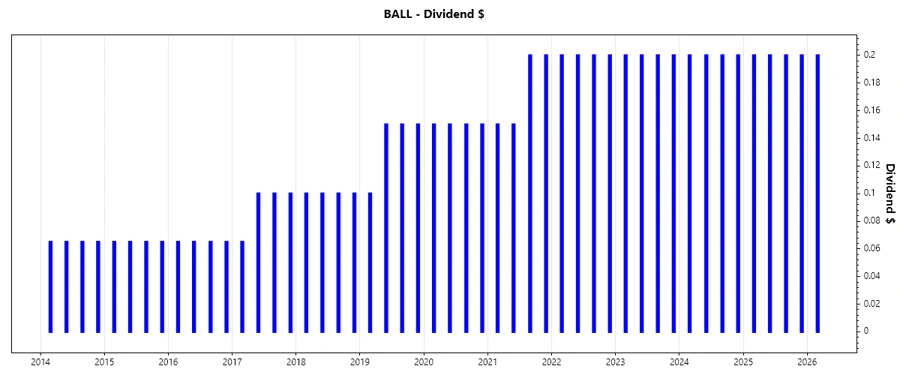
Historical analysis of dividends reveals sustainability and growth potential. Ball Corporation's long-standing dividend history is a testament to its commitment to returning value to shareholders.
| Year | Dividend per Share (USD) |
|---|---|
| 2026 | 0.20 |
| 2025 | 0.80 |
| 2024 | 0.80 |
| 2023 | 0.80 |
| 2022 | 0.80 |
📈 Dividend Growth
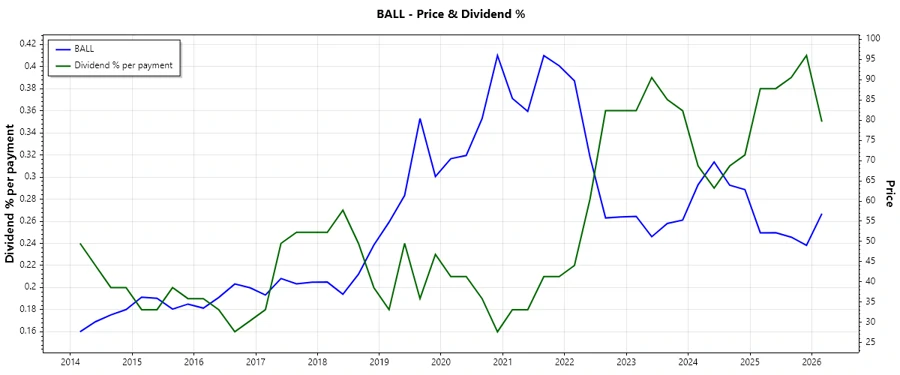
Understanding dividend growth is crucial, as it reflects the company's financial health and its commitment to increasing shareholder returns over time. The recent data shows limited growth, indicating a potential need for strategic adjustments.
| Time | Growth |
|---|---|
| 3 years | 0% |
| 5 years | 5.92% |
The average dividend growth is 5.92% over 5 years. This shows moderate but steady dividend growth.
💼 Payout Ratio
The payout ratio provides insight into the sustainability of dividends. With a payout ratio of 31.96% (EPS) and an astronomic 152.91% (FCF), there's a discrepancy between earnings and cash flow coverage, raising concerns about long-term dividend viability if cash flow issues persist.
| Key figure | Ratio |
|---|---|
| EPS-based | 31.96% |
| Free cash flow-based | 152.91% |
💧 Cashflow & Capital Efficiency
An analysis of cash flow efficiency and capital metrics is essential for understanding financial stability and operational effectiveness. Despite robust earning yields, operating inefficiencies indicated by low cash flow ratios could undermine dividend sustainability.
| Year | 2024 | 2023 | 2022 |
|---|---|---|---|
| Free Cash Flow Yield | -2.19% | 4.52% | -8.45% |
| Earnings Yield | 23.80% | 3.90% | 4.44% |
| CAPEX to Operating Cash Flow | 420.87% | 56.09% | 583.39% |
| Stock-based Compensation to Revenue | 0% | 0% | 0.26% |
| Free Cash Flow / Operating Cash Flow Ratio | -3.21% | 43.91% | -483.39% |
The negative free cash flow ratio and high capital expenditure highlight potential liquidity risks and capital management inefficiencies.
⚠️ Balance Sheet & Leverage Analysis
Assessment of leverage ratios indicates potential risks associated with high debt levels. Current ratios and leverage metrics suggest moderate financial pressure and necessitate cautious financial planning to alleviate potential solvency concerns.
| Year | 2024 | 2023 | 2022 |
|---|---|---|---|
| Debt-to-Equity | 1.03 | 2.27 | 2.72 |
| Debt-to-Assets | 0.34 | 0.44 | 0.47 |
| Debt-to-Capital | 0.51 | 0.69 | 0.73 |
| Net Debt to EBITDA | 3.51 | 4.47 | 4.71 |
| Current Ratio | 1.10 | 0.79 | 0.78 |
| Quick Ratio | 0.69 | 0.54 | 0.47 |
| Financial Leverage | 3.01 | 5.12 | 5.75 |
The elevated debt-to-equity and net debt to EBITDA ratios require careful monitoring to maintain financial health.
✅ Fundamental Strength & Profitability
Profitability and return on investment metrics are instrumental in evaluating a company's effectiveness in generating returns on assets and equity. Ball Corporation boasts variable returns, necessitating strategic improvements to enhance overall profitability.
| Year | 2024 | 2023 | 2022 |
|---|---|---|---|
| Return on Equity | 68.37% | 18.76% | 20.77% |
| Return on Assets | 22.74% | 3.66% | 3.61% |
| Margins: Net | 33.97% | 5.88% | 4.70% |
| EBIT Margin | 7.11% | 8.94% | 7.91% |
| EBITDA Margin | 12.37% | 14.64% | 12.30% |
| Gross Margin | 15.59% | 14.28% | 11.48% |
| Research & Development to Revenue | 0% | 0.46% | 0.36% |
Strengthening return metrics and margins signifies the potential for enhanced operational profitability. Long-term sustainability depends on addressing low research investments.
📉 Price Development
📝 Dividend Scoring System
| Category | Score | Score Bar |
|---|---|---|
| Dividend yield | 3 | |
| Dividend Stability | 4 | |
| Dividend growth | 2 | |
| Payout ratio | 2 | |
| Financial stability | 3 | |
| Dividend continuity | 5 | |
| Cashflow Coverage | 2 | |
| Balance Sheet Quality | 3 |
Total Score: 24/40
📌 Rating
Ball Corporation securely maintains a moderate rating, dictated by its robust dividend history and continuity. However, the elevated free cash flow payout ratio and limited dividend growth curtail its appeal to growth-oriented investors. Potential investors should weigh the stable dividend history against essential cash flow concerns.
Smart Data Insight
Master the Perfect Entry & Exit for this Stock
Don't leave your profits to chance. Historically, this stock follows specific seasonal patterns that institutional traders use to maximize returns.
- ✅ Identify the "Golden Buying Window"
- ✅ Avoid high-risk correction cycles
- ✅ Backtested data from the last 20+ years