
May 01, 2026 a 04:03 am
ABT: Trend and Support & Resistance Analysis - Abbott Laboratories
Abbott Laboratories has demonstrated a diverse range of healthcare products, enabling it to maintain a resilient market position. Recent data indicates volatility, necessitating keen observation for potential investors. Its diversified portfolio provides a cushion against sector-specific downturns. Still, investors should consider global healthcare demands and competitive pressures.
Trend Analysis
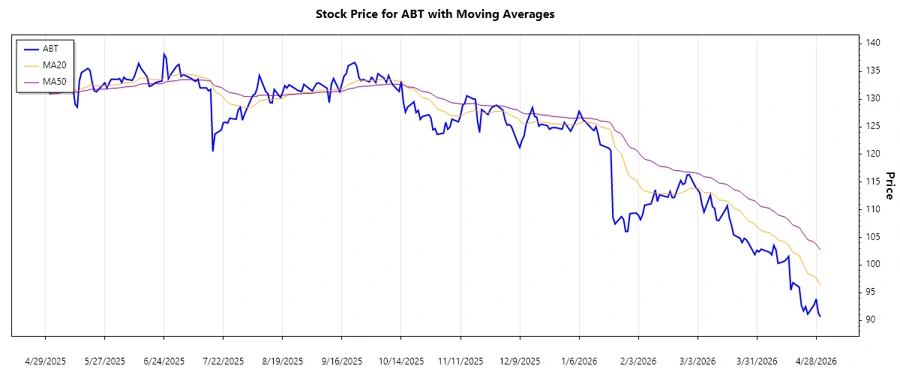
The analysis of the stock price movement of Abbott Laboratories reveals crucial insights into its recent trading behavior. The calculation of the Exponential Moving Averages (EMA) over 20 and 50 days offers a lens into the trend pattern. Using these data points, the dominant stock price trend over the most recent period is explored.
| Date | Close Price | Trend |
|---|---|---|
| 2026-04-30 | 90.63 | ▼ |
| 2026-04-29 | 91.33 | ▼ |
| 2026-04-28 | 93.86 | ▼ |
| 2026-04-27 | 92.80 | ▼ |
| 2026-04-24 | 91.13 | ▼ |
| 2026-04-23 | 92.48 | ▼ |
| 2026-04-22 | 91.70 | ▼ |
The consistent downward movement, represented by the EMA20 being less than the EMA50, indicates a prevailing downward trend. This suggests caution when considering new positions in the short term.
Support and Resistance
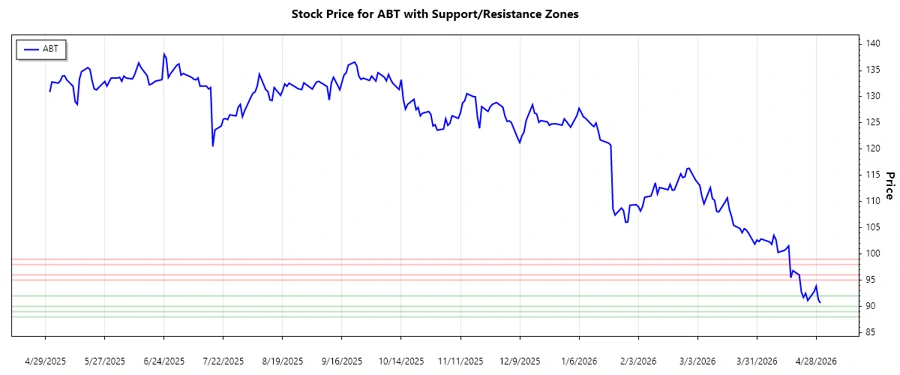
Identifying support and resistance zones is crucial for understanding the potential limitations in price movements of Abbott Laboratories stock. These zones help define price ranges where the stock might experience a reversal or consolidation.
| Zone Type | From | To |
|---|---|---|
| Support 1 | 90.00 ▲ | 92.00 ▲ |
| Support 2 | 88.00 ▲ | 89.00 ▲ |
| Resistance 1 | 95.00 ▼ | 96.00 ▼ |
| Resistance 2 | 98.00 ▼ | 99.00 ▼ |
The current price level trends at the lower boundary of the identified support zones, indicating potential for a reversal should buyer interest increase.
Conclusion
Abbott Laboratories' stock exhibits a bearish trend as described by the technical indicators, although its position within the current support zone may herald stabilization or a reversal. Investors should be informed of the volatile market dynamics impacting the healthcare sector. The intersection of support and resistance zones could present strategic entry or exit opportunities. An active appraisal of macroeconomic factors will be crucial in future decision-making processes. The global demand for healthcare solutions remains a sustaining factor, favoring long-term investment horizons even amid short-term fluctuations.